Thu Sep 10 2026
Case study
How a global shipping and logistics leader reached 110% CX goal attainment with Transcom’s AI training.
Client profile.
With a presence in more than 200 countries and territories, this global shipping and supply chain management company provides ground and air transportation, freight services, and retail shipping solutions. Operating at a vast scale, the logistics leader drives approximately $60 billion in annual revenue by delivering billions of packages each year. Comprehensive customer experience provides a crucial touchpoint between the businesses and the millions of customers that rely on its network. This requires a highly skilled, multi-lingual support workforce capable of resolving complex issues efficiently while providing the personalized, precise service customers expect from a global logistics frontrunner.
Case summary.
Facing a slow journey to proficiency among its US inbound billings hires, the logistics leader’s CX operations needed an efficiency boost. Longer ramp periods contributed to inconsistency in agent readiness, increasing average handle time while reducing new hire retention. To accelerate expertise while enhancing both agent and customer experiences, the logistics leader partnered with Transcom in early 2026. Together, we engineered an AI-powered simulation training and development program tailored for their new-hire curriculum. Through realistic simulated interactions and immediate feedback, agents strengthened critical behaviors and gained confidence rapidly before confronting live customers. Within 30 days, this boosted CX, average handle time, likelihood to recommend, and training-class retention.
The challenge.
When this global shipping and logistics company approached Transcom, their US inbound billing operation was experiencing friction along the customer journey. The cause identified was that as new hires finished their initial classroom training and entered the production floor, their performance varied significantly across resolution rates, call quality, agent empathy, and handle times. This created a visible gap between the brand’s expected service standards and the actual experience customers received on the phone.
The problem extended beyond basic customer satisfaction metrics. Longer ramp times directly contributed to higher average handle times. When new agents took longer to find answers or navigate the billing systems, the calls stretched out. These higher handle times required the client to allocate more resources to support the same interaction volumes. During this period, the customer experience score and likelihood to recommend (LTR) performance fell short of the client’s targets.
In partnership with the logistics leader, Transcom traced the root challenge to the initial preparation phase. Traditional training methods offered limited opportunities for new hires to practice realistic interactions. Instructors taught the policies, but agents rarely received consistent, individualized feedback on how to apply them in a live conversation. This lack of practical experience contributed to lower agent confidence on live calls. The result was agent overwhelm that drove higher attrition rates among the newest employees. The client needed a scalable way to accelerate proficiency, build agent confidence, and deliver a consistent customer experience without increasing operational costs.
The solution.
In early 2026, Transcom devised, implemented, and governed an AI simulation training and development program to be embedded software directly into the client’s new-hire curriculum. Our project team gathered a rich set of inquiries representing the majority of customers’ reasons for contacting support, transforming these into realistic, automated role-play scenarios. This tool gave new hires repeated opportunities to practice, perform, and refine their skills fully well in advance of handling live interactions.
Calibrating the system specifically to the shipping and logistics leader’s requirements, our team’s training simulations drew directly from the client’s knowledge base, brand tone, internal policies, and billing resolution frameworks. This created a standardized training environment that accurately mirrored the interactions agents would encounter in production. New hires were able to practice throughout their initial training and nesting periods, developing their confidence and brand alignment ahead of assuming a full production role.
Generating real-time quality scores and behavioral insights, the software reported on metrics tied directly to the skills driving customer satisfaction, likelihood to recommend, and resolution efficiency. Trainers could then immediately pinpoint specific development opportunities for each agent and provide targeted coaching. At the same time, agents received an immediate feedback loop, repeating the scenario to optimize their approach. This transformed the training structure from periodic, subjective role-play and reactive quality evaluation into a proactive development model driven by concrete data. Reducing performance variability and accelerating new hire proficiency, it ensured consistent support for global customers from an agents’ very first day.
The results.
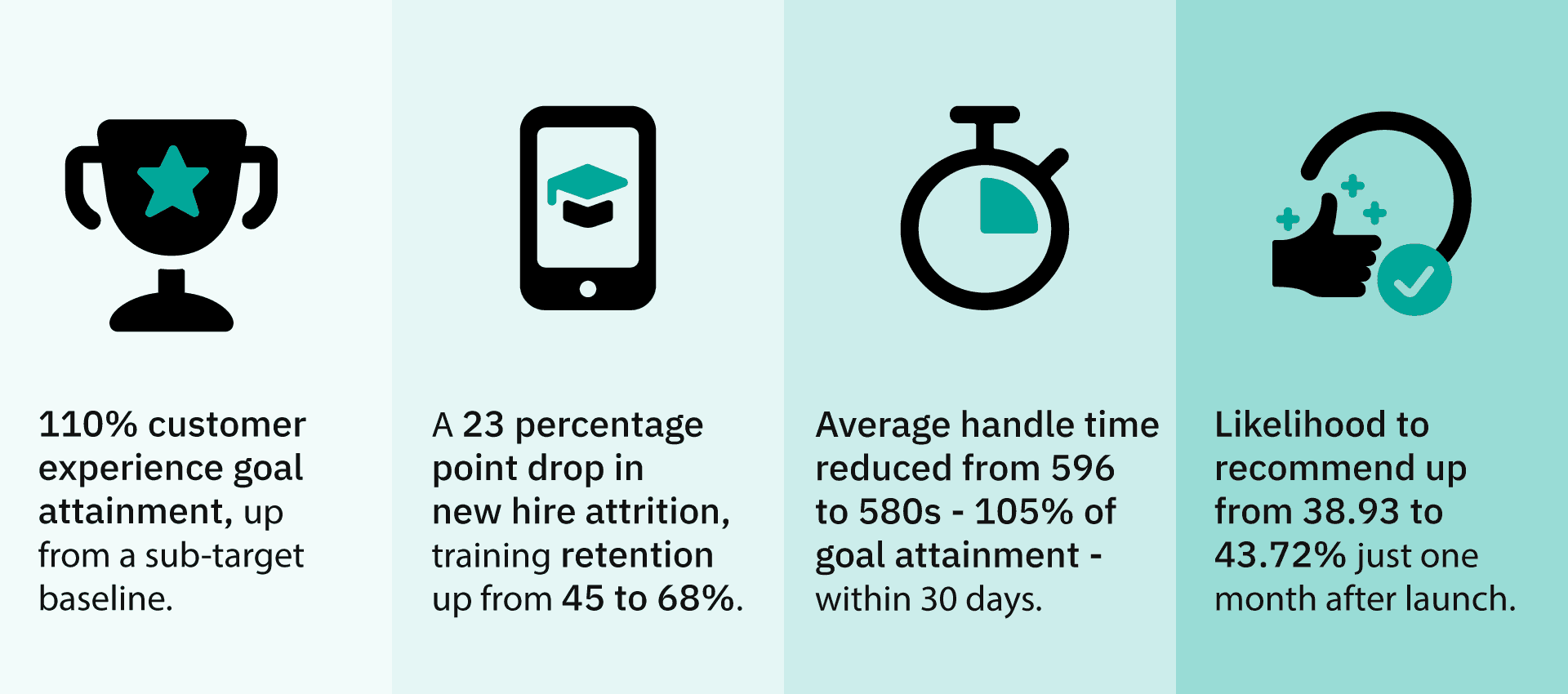
Partnering with Transcom brought immediate results for the shipping and supply frontrunner. Within the first month of deployment, our simulation program boosted performance across customer experience, efficiency, and new-hire retention. Agents’ elevated levels of preparation and confidence led to a massive change in staffing stability, with training-class retention rising from 45% to 68% - a 23 percentage-point increase in new-hire retention.
Service quality metrics saw similar growth as the agents applied their simulated practice to live calls. The logistics leader’s customer experience score increased from 3.83 to 4.41. This progress moved performance from a baseline below the company’s target up to 110% customer experience goal attainment. Overall brand perception improved alongside this, with likelihood to recommend increasing from 38.93% to 43.72%, with this shift alone driving a 9% increase in goal attainment.
In addition to these quality boosts, operational efficiency improved substantially. Average handle time dropped from 596 seconds to 580 seconds, creating a significant reduction in the resources required to support vast interaction volumes. This brought the operation to 105% Average Handle Time goal attainment. Ultimately, by giving new hires the opportunity to practice, receive immediate feedback, and build confidence rapidly before going live, our partnership delivered the efficiency the global logistics frontrunner required, while not only maintaining, but improving CX and agent experience quality at scale - a combination set to drive sustainable rewards across growth and ROI.