Tue Sep 29 2026
Case study
How a consumer electronics leader reached 101% of its NPS goal within 30 days of AI simulation training.
Executive summary
Client profile.
This global consumer electronics leader is a dominant force in the technology sector, recognized for its vast ecosystem of smartphones, home appliances, and connected technology. With annual revenues exceeding $230 billion in 2025, the brand manages more than 1 billion active smartphone users and leads the U.S. market in consumer consideration across personal technology and household appliances. Its North American operations are critical to its international footprint, requiring high-touch support for a customer base that expects seamless experiences across premium hardware, software, and connected devices.
Case summary.
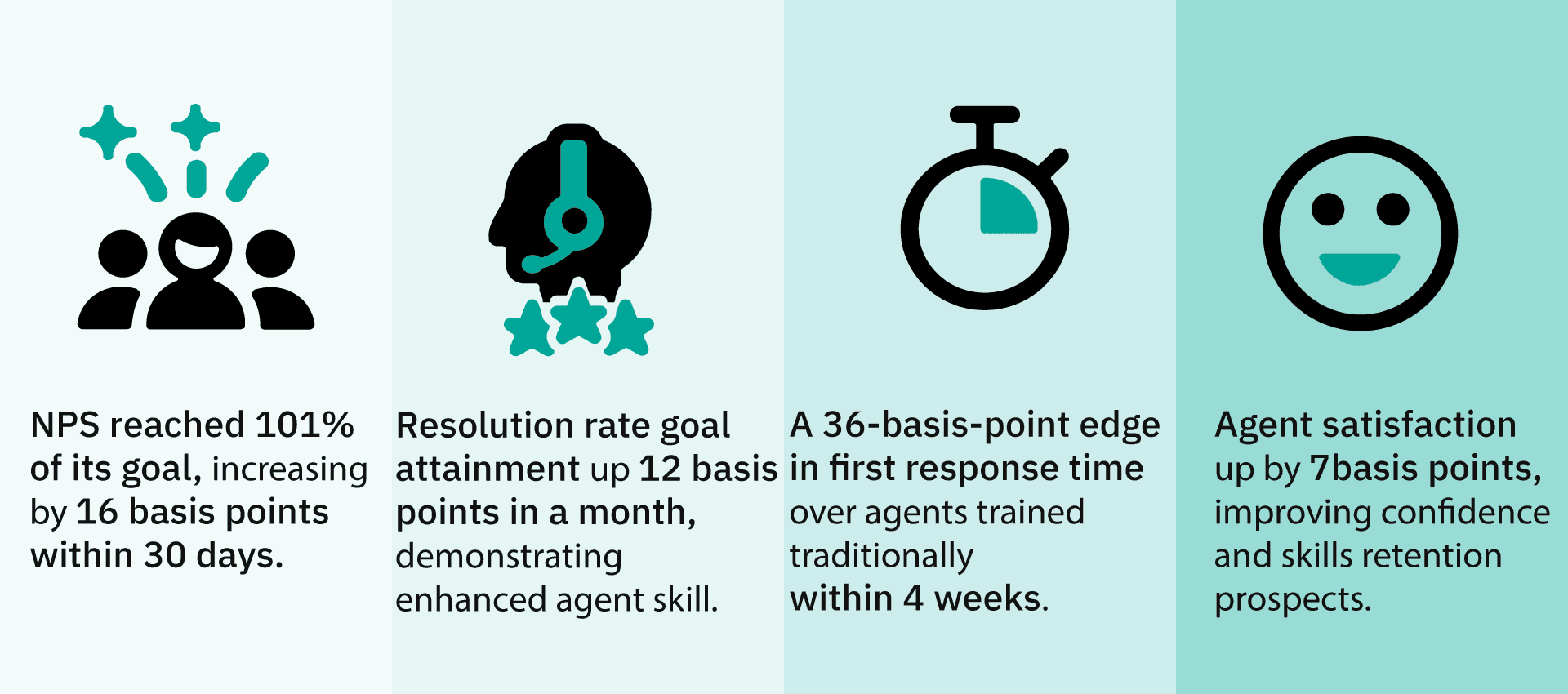
As customer interactions became increasingly complex, the consumer electronics leader needed to accelerate new-hire proficiency and strengthen performance across its Live Chat support channel. Transcom introduced AI-powered simulation training and automated quality scoring, giving agents a realistic environment to hone communication and technical skills before entering production. Within 30 days, agents trained through AI simulation reached 101% of the client’s NPS goal, representing a 16-basis-point advantage in goal attainment over the traditionally trained cohort. Goal attainment across resolution rate, first response time, and agent satisfaction also rose by 12, 36, and 7 basis points respectively, delivering a more efficient path to production and improving customers’ Live Chat experience.
The challenge.
For a global consumer electronics brand, delivering premium products is only part of the customer experience. Support teams must be equally capable of navigating complex technical questions while creating the high-touch interactions customers expect from the brand. This tech leader’s agent training model was struggling to prepare new hires for that reality quickly enough. Agents were entering Live Chat production without sufficient opportunities to practice the communication, troubleshooting, and customer connection skills required in real conversations.
That gap showed up across key performance indicators. Resolution rates and agent satisfaction were inconsistent, while first response time remained a challenge as agents attempted to balance customer engagement with Live Chat concurrency. The client needed a more effective way to accelerate proficiency, standardize quality, and give new hires the confidence to deliver strong customer experiences from the moment they entered production.
The solution.
The consumer electronics leader partnered with Transcom to transform new-hire preparation by integrating AI simulation directly into training. Instead of relying primarily on traditional learning methods, agents practiced through realistic, natural-language Live Chat simulations modeled on actual customer interactions. Scenarios covered brand-specific communication, technical troubleshooting, compliance requirements, and a range of customer personas and conversation paths.
Each simulation was supported by automated AI quality scoring, evaluating critical skills including empathy, listening, rapport building, and resolution. Trainers received immediate performance insights, allowing them to identify individual skill gaps and deliver targeted coaching before agents entered live production. This created a continuous learning loop of practice, feedback, coaching, and improvement, helping agents build both technical proficiency and customer connection skills in a controlled environment before applying them with real customers.
The results.
Within 30 days, AI simulation-trained agents outperformed the traditionally trained cohort across every measured effectiveness and efficiency KPI. Most significantly, NPS goal attainment improved by 16 basis points, reaching 101% of the client’s target. Resolution rate goal attainment increased by 12 basis points, demonstrating stronger agent proficiency and a greater ability to successfully resolve customer needs.
Agent performance improved without sacrificing speed. Their first response time goal attainment increased by 36 basis points, even as they navigated the concurrency demands of Live Chat support. The impact extended to the agent experience as well, with agent satisfaction goal attainment improving by 7 basis points compared with the traditionally trained cohort. This signals greater confidence and readiness when entering production.
Together, these results demonstrate that AI simulation can do more than modernize training. By partnering with Transcom to provide agents with a realistic environment to practice, learn, and improve before interacting with customers, the electronics leader gained a faster path to proficiency while strengthening customer loyalty, resolution, efficiency, and agent retention prospects. This successful pilot provided a scalable foundation towards a more consistent and sustainable way to prepare the tech brand’s next generation of CX talent.