Thu Sep 10 2026
Case study
How a food tech support team scaled by 34 agents in 48 hours to match legacy performance in 3 weeks.
Executive summary.
Processing tens of thousands of live transactions daily, this leading food service platform required an agile CX partner that could maintain reliable coverage and swift support for its vast restaurant network. Before partnering with Transcom, their providers suffered from high absenteeism and attrition, resulting in disconnected vendor relationships and direct risks to transaction processing times and overall service levels.
Client profile.
This technology company provides a comprehensive digital platform to food service businesses, aggregating online orders, connecting third-party delivery applications, and integrating directly with restaurant point-of-sale systems. Its software allows restaurants to manage their entire digital ordering networks from a single centralized interface. To handle tens of thousands of daily live transactions across multiple business lines and third-party delivery providers, the tech brand depends on a high-volume, efficient support operation. As digital orders increase among food service users, the platform must ensure swift transactions, accurate data, and reliable support coverage to drive smooth operations and secure loyalty from its thousands of restaurant clients.
Case summary.
Experiencing absenteeism and coverage issues with previous providers, the food tech platform partnered with Transcom instead. The engagement began with a small initial team in Latin America before a sudden volume swell required rapid expansion into the Philippines. Transcom sourced, interviewed, and deployed 34 new team members within two business days. This new team matched the proficiency and accuracy of legacy providers within only three weeks. Operations managers also identified and resolved multiple workflow inefficiencies during the initial rollout.
The challenge.
This food service tech provider processes large volumes of daily transactions, all bound by strict service level agreements. Meeting these operational targets requires highly consistent workforce coverage. Before working with Transcom, the client experienced high absenteeism and attrition among its existing outsourcing providers. These staffing fluctuations created a direct risk to transaction processing times and overall service levels. The company wanted a different operating model. Management preferred direct visibility into operations rather than a disconnected vendor relationship. They needed a partner willing to share frontline agents’ real observations.
Shortly after partnering with Transcom on this, with a ten to fifteen person team in Latin America, the client experienced an unexpected surge in transaction volume. This created an immediate need for additional capacity, and the client requested a rapid expansion into the Philippines. As the newest provider, Transcom needed to match legacy teams’ understandings of processes, internal systems, and performance expectations in record time. The core operational challenge was to add 30+ team members almost immediately without the drop in quality typical with rapid hiring.
The solution.
The expansion timeline began on a Friday morning with the client’s submission of an urgent request for significant additional capacity. Over the next five hours, operational leaders interviewed and selected 34 team members. Training for this group started the following morning. By Tuesday morning, the new team was live and actively working the queues.
To achieve this, Transcom harnessed its existing talent pool - employees who had already completed internal training programs and possessed the required foundational competencies. This allowed operations managers to bypass the standard external sourcing process and select candidates based on existing performance data, attendance records, behavior, and operational fit rather than simply hiring for availability.
Once the team entered production, they analyzed daily workflows for further efficiency opportunities, with frontline employees identifying duplicate transactions and instances where work was already processed by other departments - as well as inconsistent tagging within customer relationship management software. In some cases, existing systems routed transaction batches to support queues very near service deadlines despite an overall service level agreement allowing substantial processing windows. Transcom’s management compiled and presented these observations to the client, with our operations team suggesting specific adjustments to workflows, SLA tagging procedures, and automation triggers. Beyond greater visibility into the transaction lifecycle, this offered the platform enhancements to recover unsuccessful orders.
The results.
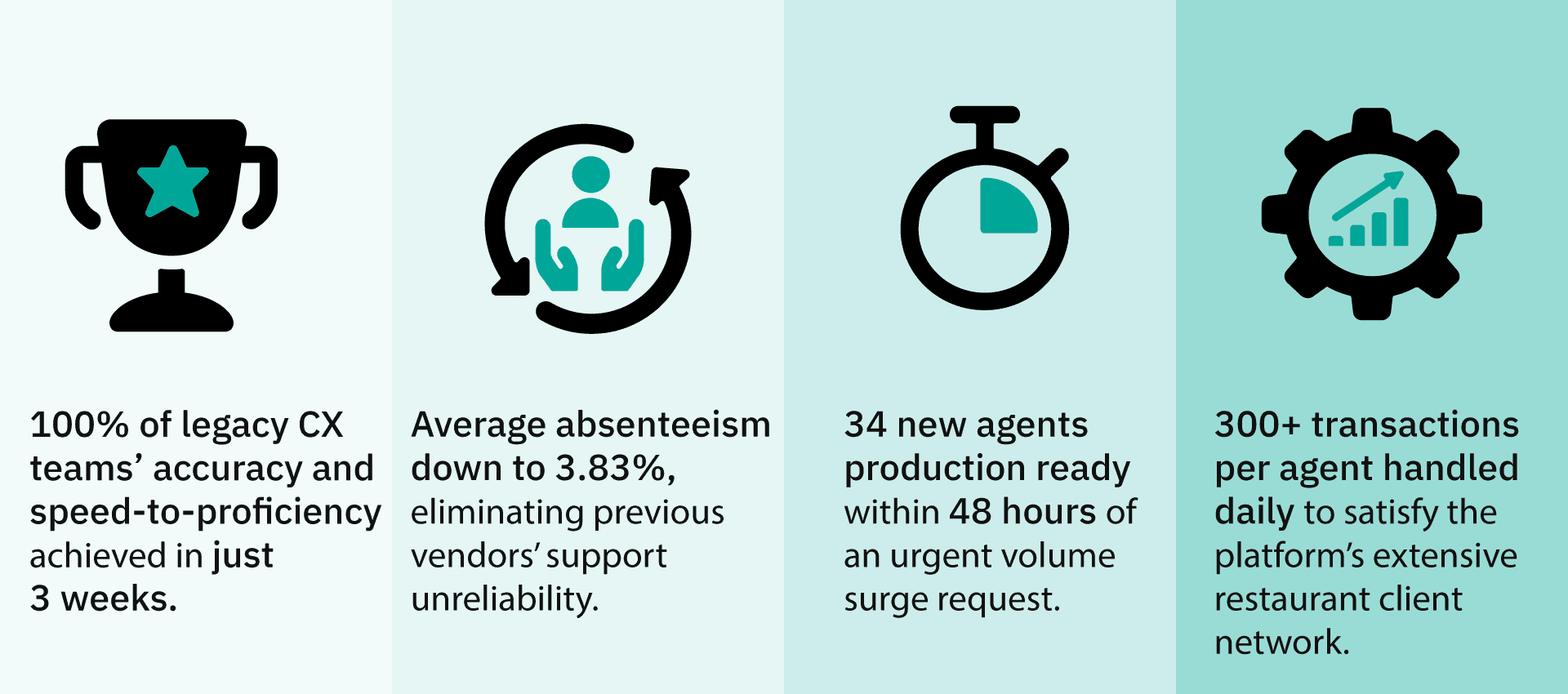
The food service platform’s partnership with Transcom rapidly scaled from an initial group of 10 to 30+ team members across two global delivery locations. Following the initial launch in Latin America, our team successfully tackled the sudden volume spike by deploying a 34-person operation in the Philippines within two business days. Notwithstanding the heavily accelerated launch timeline, the newly deployed team reached established-provider performance metrics in three weeks, matching the exact speed-to-proficiency and accuracy rates of legacy vendors with substantially greater tenure.
Despite record recruitment and ramp-up, the new workforce maintained a 3.83% average absenteeism rate. This provided the workforce stability and reliable coverage our client had been missing with its previous providers. Furthermore, each agent handled 300+ transactions per day, quickly developing the high productivity required to support the digital operations platform’s vast volume requirements. In addition to rapidly and consistently delivering these metrics, the team proactively identified workflow and CRM friction points and optimisation solutions to improve the broader operation. Partnering with Transcom not only provided the nimbleness, reliability, and quality the platform required, but establishes a self-strengthening operation fit to fuel future growth.