Thu Sep 10 2026
Case study
Our multi-brand white goods client’s success story with strategic consolidation.
The background.
A leading global white goods manufacturer faced significant operational challenges stemming from years of acquisitions and a decentralized customer service model. Their landscape was fragmented, with 25 disparate, localized contact centers spread across various regions, supporting 11 different brands in the EMEA region. Before the transformation, their customer service environment presented specific hurdles:
- Complex and varied processes across countries and brands.
- Inconsistent performance among brands, sites, vendors, and languages.
- High cost-to-serve due to a disparate, decentralized contact center network. Contact centers were historically viewed solely as an operational expense.
- Unconsolidated systems and processes.
- A high interaction volume of approximately 2.5 million customer interactions annually.
- A lack of standardization led to inconsistent customer experience across EMEA.
The solution.
Transcom implemented a strategic transformation program, aiming to convert the contact center from a cost center into a profit center. The project was initiated in 2015 and gained momentum in 2017. It is currently in the final integration phase for the 11th brand.
Transcom leveraged its position in EMEA to implement a hub-and-spoke style, multi-site solution, utilizing multiple locations across Poland, Portugal, and Hungary. This strategic move allowed the client to cover all necessary languages and significantly consolidate their footprint. A key element of the solution was establishing a competence center in Poland as a central hub, supported by spokes in three other locations. This structure enabled Transcom to:
- Provide a single point of contact for managing the entire call center network, simplifying oversight with one vendor.
- Achieve greater efficiencies by combining language queues across various brands and lines of business.
- Simplify processes across the entire operation, leading to a consistent and improved customer experience.
Key actions and strategies implemented included:
-
Strategic consolidation: migration of all 25 localized contact centers to a single, strategic supplier.
-
Standardization of processes: development and implementation of unified customer interaction protocols, consistent scripting, and communication guidelines across all brands.
-
Centralized knowledge base: creation of a single source of reliable product information, FAQs, and troubleshooting guides.
-
Unified training programs: comprehensive training for all agents focused on empathy, problem-solving, and sales skills. This includes the launch of the T:University e-learning platform.
-
Technology harmonization: deployment of a common contact center platform and tools, including the T:Rex (our Looker-based tool) reporting platform and T:Perform (our performance management platform) for performance management and communication. External databases from the client's SAP are regularly imported, and a has been built.
The results.
The partnership between Transcom and the white goods manufacturer client delivered extraordinary and measurable results, transforming operations into a unified, profit-generating asset.
Key success metrics and achievements include:
-
Exceptional Return on Investment(ROI):
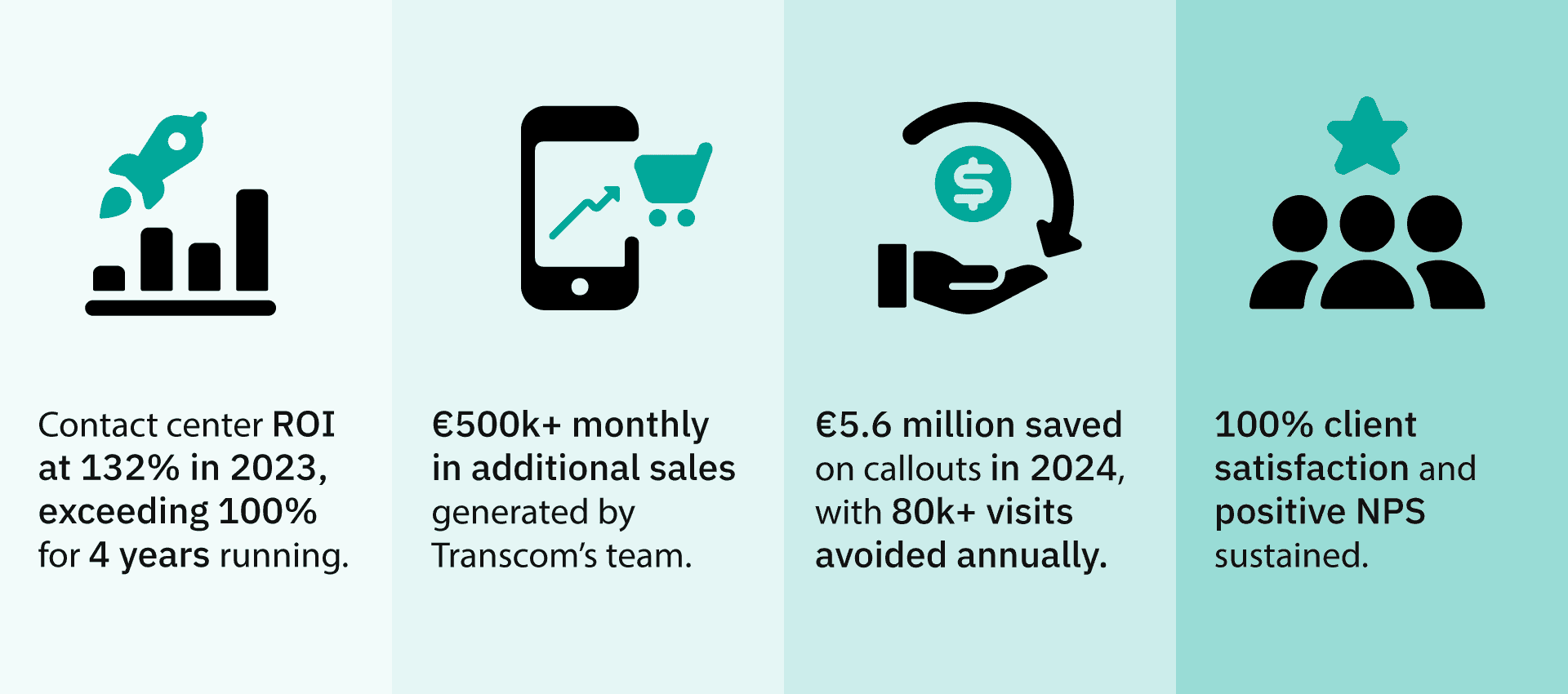
- Achieved over 100% ROIin 2021, maintaining this level for four consecutive years.
- The ROI reached an impressive 132% in 2023, and 127% in 2024. This means the revenue generated and costs avoided fully offset the contact center's operational budget.
- In 2024, €12 million in value was generated against contact center operating costs of €9 million, demonstrating exceeding 100% ROI.
- Sales generation activities are currently bringing in more revenue (over €6.6 million) than the cost of operating the contact center.
- The average value of products sold by Transcom exceeds €0.5 million monthly.
-
Significant Cost Savings and Technical Service Avoidance:
- Savings from technician visit avoidance totaled over €5.6 million in 2024 alone.
- The number of avoided technician visits is over 80,000 annually, which is well above the market benchmark.
- Service visit avoidance increased from 9% in 2015 to over 20% in 2024.
- On average, around 25% of cases are resolved via the phone channel, reducing the number of visits.
-
Enhanced Employee Experience and Operational Effectiveness:
- 100% client satisfaction with operational management, people management, account management and relations, and technology and innovation.