Published on Thu May 15 2025
Updated on Fri May 16 2025
7 minute read
As a sort of conclusion to our series of posts about learning, development, and advancement we would like to talk about planning for the future, specifically with professional development plan templates. They are a visual representation and reminder of your willingness to grow professionally. Let’s dive in, shall we?
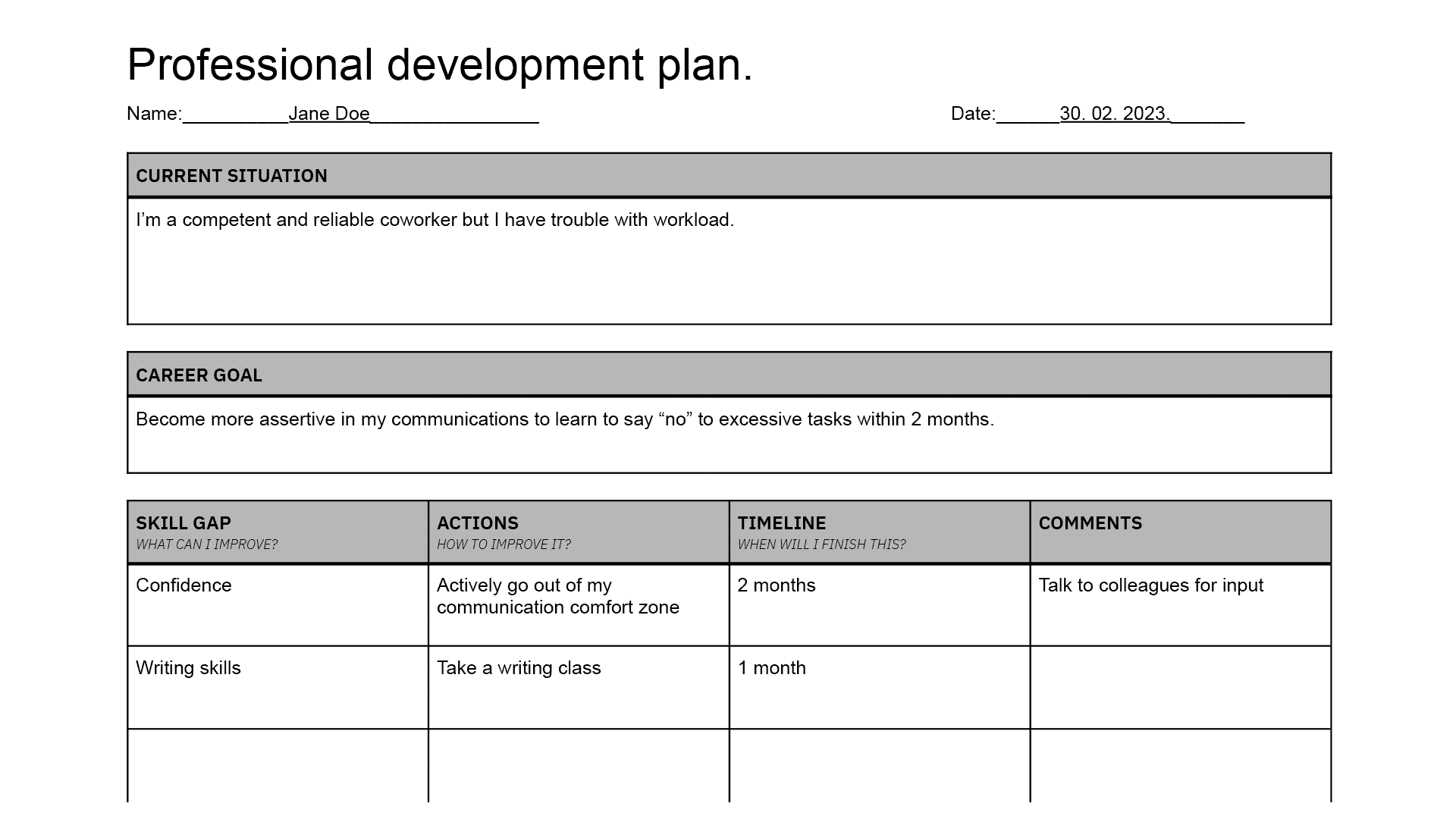
The truth is that people like to get sidetracked. We all procrastinate sooner or later. A professional development plan template serves as a reminder of what you started, when you started it, and when you plan on finishing it. That reminder is both for you and for your managers to have an idea of what you plan to accomplish. Apart from that, it also allows you to get a moire objective look at yourself, your skills, and goals. Let’s be honest, we all need that from time to time. A professional development plan template gives you that ability by asking you simple questions and making you answer them truthfully.
When you open up a professional development plan template you will have a lot of empty space that might seem too vague or too open at first, but the template itself usually guides you through itself. A good way to fill it out is to ask yourself the questions it poses and answer them truthfully and honestly.
The first question is always the hardest one. Here you need to provide yourself with an objective look at your current professional situation. What are some facts about your current position? Are you happy with where you are? How are your relationships with your colleagues? Are you performing at the level you want to?
All of these are questions you can pose yourself in order to best fulfill the professional development plan template and start your improvement journey.
The second hardest question is next. Where do you want to be? This can be anything. Do you want to get that promotion? Do you want to be a better colleague as a person? Do you want to expand the arsenal of your skills? Do you want to get better at one specific area of your work? Do you want to become a better communicator? These are all absolutely valid.
The important thing to remember here is that you put down a goal that you really care about because that means you will actually strive to accomplish it. The second thing you need to do is give yourself a timeframe. It’s not enough to say: “I’ll learn this skill.”, you have to say: “I’ll learn this skill in six months.” This time limit doesn’t have to be strict, you can absolutely be lenient with yourself, but you need to put it and stick to it. Thirdly, the goal in your professional development plan template needs to be SMART.
SMART is an acronym that stands for: specific, measurable or motivational, achievable, relevant, and time-bound. Let’s explain these by giving a bad example of a development goal.

Created at Tue Apr 07 2026
4 min read
When you hear customer experience, you probably think of a frontline function. What comes to mind: response times, tone of voice, escalation paths, or another factor that seems downstream of your operational core? It’s time for a CX reality check.
Far from being a procedural extension of a stable system, customer experience is shaped by - and shapes - your business’s constant transitions. When warehouses migrate, when platforms change, when regulations evolve, ‘frontline’ decisions must be

After setting your goal you need to think about skills or habits that you need to achieve it. Let’s continue with our example of getting better at Python. Maybe you need to improve your knowledge of Python frameworks or libraries so that your code is more efficient. Maybe your issue is not with knowledge but with attention. Maybe what you lack is focus and you make errors or create code that could be written in a sleeker way. Maybe it’s both.
Once you figure out what it is that you need, you need to put it all in the professional development plan template and then move on to step two.
This is the detailed part of the template. Here you put exactly how you plan on acquiring the skills you lack. Need more knowledge on libraries? Start reading up. Need to get better at focus? Do exercises that help with attention span.
You can put any way you plan on obtaining these skills. From personal, individual practice, reading up on things, attending workshops and seminars, and enrolling in courses. Doesn’t matter as long as you have a clear vision of how to go about it.
Lastly, as with setting career goals, so with smaller developmental goals. You need to add a time limit. Setting time limits on your developmental goals is important for a number of reasons: Focus: When you set a deadline, it allows you to concentrate on what needs to be done. It helps you to prioritize tasks and focus your energy on achieving the goal. Motivation: Deadlines create a sense of urgency. This can motivate you to start working towards your goal, instead of procrastinating or delaying. Achievement: Setting and meeting deadlines gives a sense of accomplishment. Each met deadline is a step forward towards your overall goal. Efficiency: Deadlines force you to be efficient. They make you plan, organize, and manage your time effectively. Prevents Perfectionism: Without a deadline, there's always more time to tweak, adjust, or redo work in the pursuit of perfection, which can lead to never completing the task. A deadline forces you to aim for done over perfect. Remember, as with all goals in your professional development plan template, the key is to set realistic and achievable deadlines. Setting overly ambitious deadlines may cause unnecessary stress and may be counterproductive

Created at Thu Apr 02 2026
3 min read
AI is accelerating faster than enterprise operating models were designed to handle. In every organization, transformation is underway. Roadmaps are expanding, budgets are shifting, and expectations from boards and customers are rising. But acceleration without structure creates volatility - and customer experience is no exception to the rule. While technology introduces possibility, leadership determines whether that possibility becomes measurable value or a mere disruption.
Navigating this ten

Created at Wed Apr 01 2026
6 min read
Development is no longer the hardest part of the gaming industry. After decades spent perfecting the art of building worlds, even challenger studios now have access to powerful engines, efficient collaboration pipelines, and global development teams that can consistently ship high-quality titles.
The greatest challenge gaming companies confront today - the one that separates noobs from pros? It’s all about what happens after launch: the moment players show up. That’s when the game changes, bec