inclusion and diversity,
DEI,
Published on Thu May 15 2025
Updated on Fri Aug 08 2025
6 minute read
In the dynamic landscape of job hunting, understanding the diverse threads that weave through workplaces is your secret weapon. It's not just about scoring a job - it's about thriving, evolving, and truly enjoying the workplace you’re in. So, grab your coffee (or tea, we're inclusive here at Transcom) and let's unravel the mysteries of workplace diversity - why it’s important, why you should care, and what types of diversity are there.
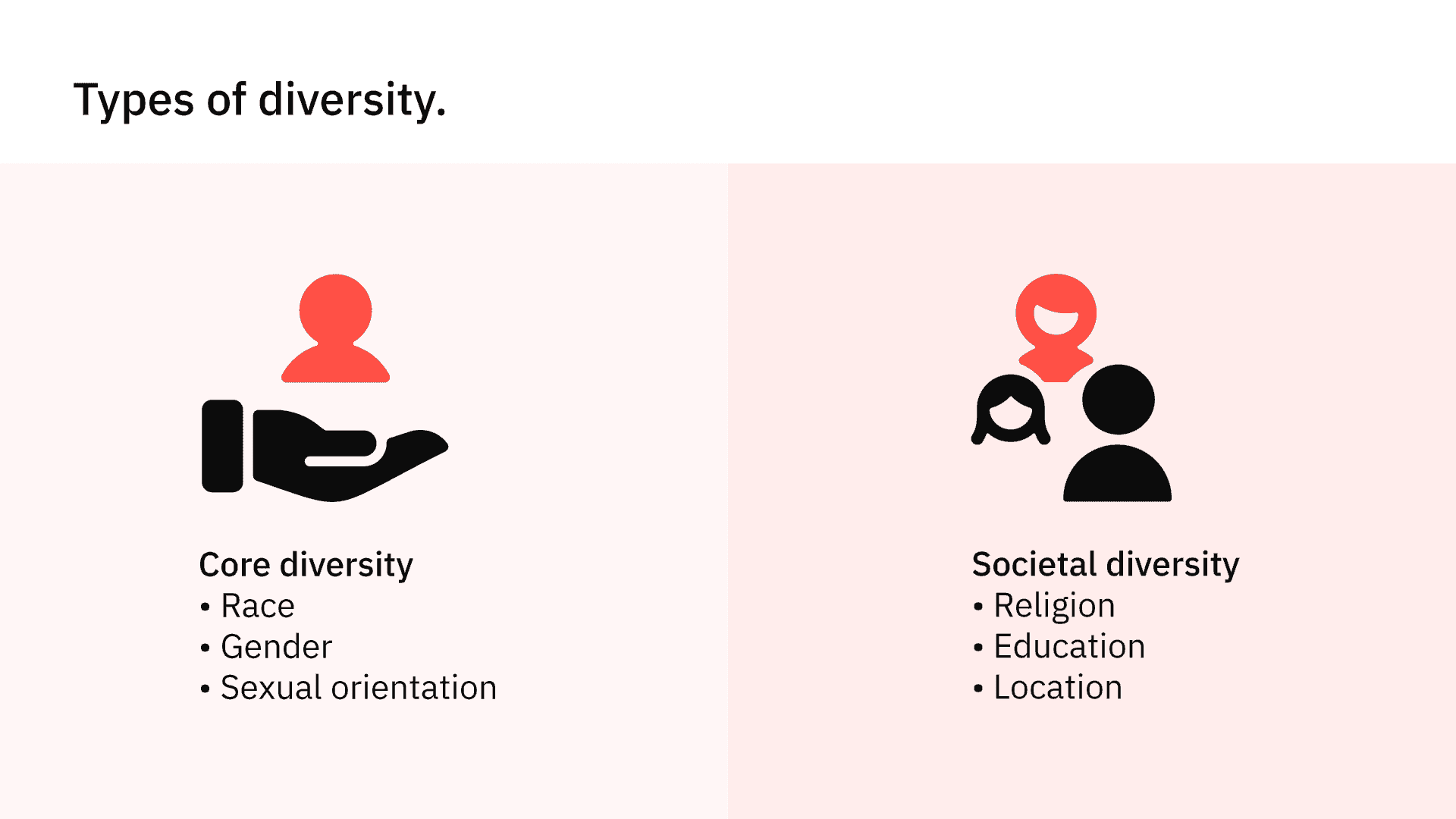
Understanding the various types of diversity is crucial for several reasons, as it allows for the recognition, appreciation, and promotion of inclusivity and equality within a society or organization. They can be split into two categories: core and societal diversity. Here's an exploration of different types of diversity and why they matter. This is just the tip of the iceberg, made to show that there’s more to diversity than first meets the eye. We all understand why diversity is important to businesses, and to us as individuals, but this section will try to show why diversity should be important to you as a job seeker.
This category is concerned with diversity from an internal standpoint. In essence, it's a concise journey into what makes you uniquely you, from the intricacies of your genetic makeup to the depths of your psychological landscape and the enduring qualities that shape your nature. Here is just a fraction of the kaleidoscope of factors that make us unique. The list is nowhere near complete and we will visit these and more in greater detail down the road.
Racial diversity is a pivotal consideration when searching for a job due to its multifaceted impact. Firstly, it fosters innovation and creativity, exposing individuals to a variety of perspectives that drive dynamic problem-solving. Beyond professional growth, diverse workplaces mirror the broader world we live in, creating environments that resonate with authenticity and representation. This exposure also enhances cultural competence, a critical skill in our interconnected world. Lastly, job satisfaction tends to be higher in workplaces with these types of diversity, contributing to a positive work experience.
Gender-diverse workplaces are known for promoting equality and offering a more balanced representation of talent, which positively impacts decision-making and general skill level. While the case used to be that you had to be a man to get a job, things are moving to a position where nothing matters apart from your skills. Which ultimately means that gender diverse workplaces are the ones that are doing a better job than the rest.

Created at Mon Aug 10 2026
10 min read
Cutting costs by 40% to 70%, achieving 24/7 service coverage, and accessing a vast global talent pool of skilled workers are just a few reasons why offshore business process outsourcing (BPO) could be your company’s next competitive advantage. Strategic benefits ranging from enterprise-grade tech to airtight security - all financed flexibility without steep upfront investments - are driving businesses of every scale to delegate more non-core functions to overseas providers. But doing
Sexual orientation diversity is a crucial consideration in the job search, as it fosters a workplace environment that values and respects the authenticity of every individual. Ultimately, job seekers who prioritize and appreciate sexual orientation diversity contribute to and thrive in workplaces that celebrate the diversity of human identity and expression. It shows companies what we deem important as a society, and diverse workplaces show that, as we like to say it, everyone can come as we are, and feel safe and accepted.

Other types of diversity are influenced not by you as a person, a human being or a living organism but the society you live in, as a citizen and individual. These range from just living in the place you live in to accepting or rejecting certain societal norms. From tolerance to absolute acceptance and community. Again, these are just examples, and nowhere near everything diversity has to offer, but they serve as a good jumping off point for later articles and your own delving into the topic.
Religious diversity is a significant consideration when searching for a job as it fosters a workplace environment that embraces and respects individuals' diverse belief systems. Inclusive workplaces that value religious diversity contribute to a culture of tolerance and understanding. Sharing your customs with others brings us closer together, and respecting or even celebrating our religious choices and differences shows that what truly matters is the faith in the human spirit and unity above all.
Educational diversity is a vital consideration when seeking employment, as it brings a spectrum of skills, knowledge, and perspectives to the workplace. In a diverse educational environment, individuals with varied academic backgrounds contribute unique approaches and creative thinking. Moreover, a mix of educational backgrounds promotes a collaborative culture, where individuals learn from each other's expertise. Also, everyone can bring their unique twist to tasks. A copywriter versed in music can help out video editors. Designers who took creative writing classes can bring a fresh perspective to texts. The main point is not purely in your education, but how you use it.
With the advent of the work-from-home era, a diversity of locations people are in is becoming of greater and greater importance. A widespread team has its challenges but the pros outweigh the cons. Prioritizing location diversity aligns with the reality of businesses like Transcom which are operating on a global scale, positioning individuals to thrive in diverse markets and contribute meaningfully to the success of their organizations. As a person you are enriched by experiences from cultures near or far to you which allows you to grow both as a professional and individual

Created at Fri Aug 07 2026
4 min read
The majority of companies - across all industries and all geographic regions - handle their customer service processes internally. It is hard to get specific data on a percentage split between in-house customer service and outsourcing this to a partner because it varies from region to region and industry. However, analyst estimates vary from approximately half to three-quarters of all companies handling all customer experience (CX) processes internally. So there are a lot of companies out there

Created at Tue Jul 28 2026
4 min read
It happens every peak season. A customer fills their basket, makes it all the way to checkout, and then vanishes. Maybe they’re afraid their order would arrive in the middle of their getaway. Maybe the page just takes a little too long to load. Whatever the reason, they close the tab on your brand. Some tell themselves they'll come back later. Most never do. For retailers, those moments are easy to dismiss because they happen one customer at a time. But during peak periods, they happen thousands