A guide to understanding customer service data analytics...

Customer service analytics,
data analytics,
Published on Thu May 15 2025
Updated on Fri Aug 08 2025
7 minute read
We’re going into the world of customer service data analytics, exploring the various touchpoints, types of data, how important they are, and best practices for leveraging data to deliver exceptional CX.
What are customer service data analytics?
The importance of customer service data analytics.
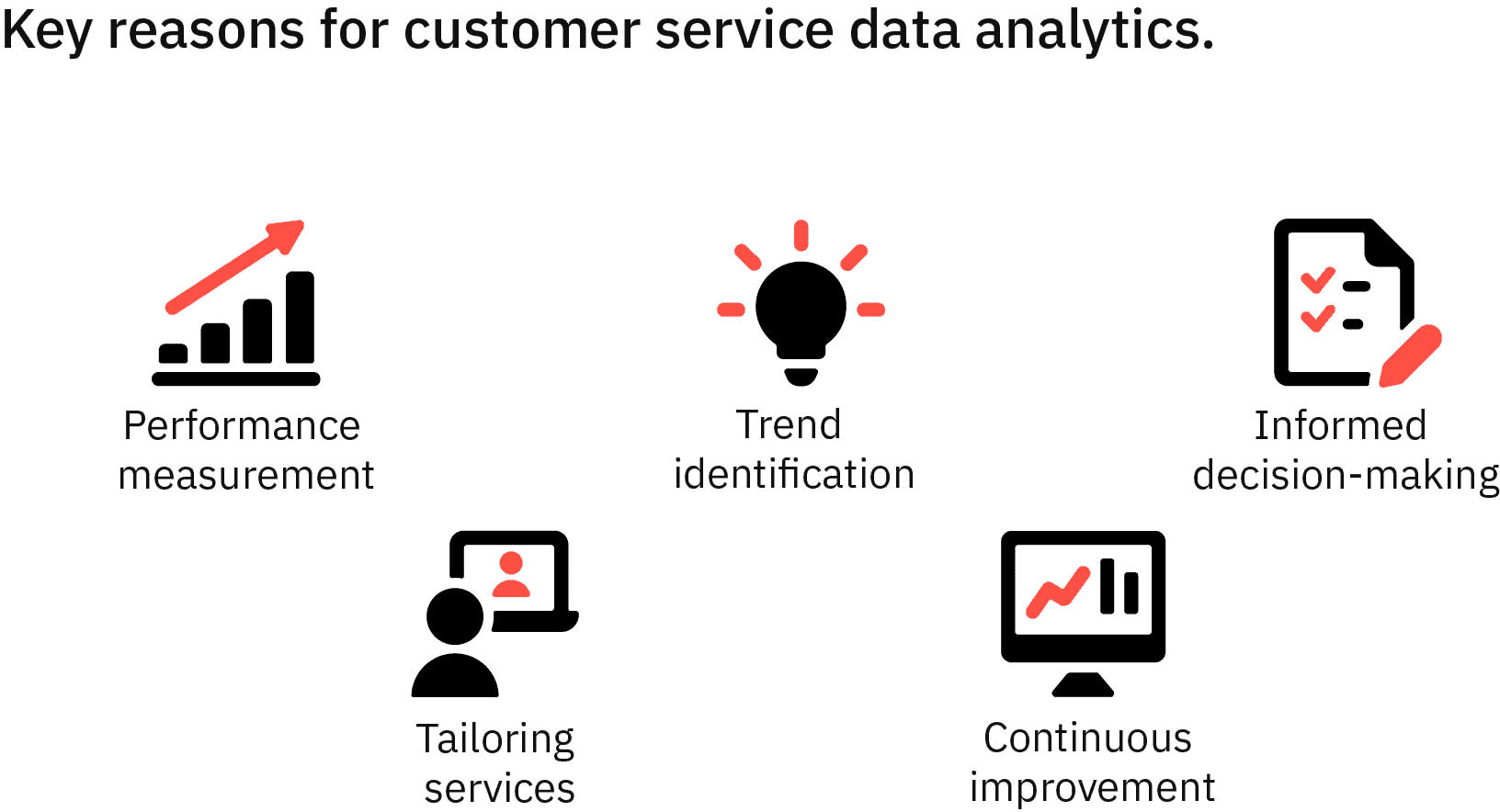
- Performance measurement: By analyzing data, businesses can track key performance indicators (KPIs) such as average handle time, first contact resolution rate, and customer satisfaction scores. This allows for objective assessment of service quality and areas for improvement.
- Trend identification: Data analytics helps uncover patterns and trends in customer behavior, inquiries, and feedback. This enables businesses to proactively address emerging issues, anticipate customer needs, and tailor their service offerings accordingly.
- Informed decision-making: Data-driven insights guide strategic decision-making, resource allocation, and process optimization in customer service operations, leading to more efficient and effective service delivery.
- Tailoring services: By analyzing customer data, businesses can gain a deeper understanding of individual preferences and needs. This allows for delivering personalized interactions and recommendations, fostering stronger relationships and brand loyalty.
- Continuous improvement: Data analytics provides a continuous feedback loop for measuring the impact of service initiatives and identifying areas for further enhancement. This supports a culture of ongoing improvement and adaptation in customer service
Some of the key metrics in customer service data analytics.
- Customer satisfaction (CSAT): CSAT surveys directly measure customer satisfaction with specific interactions or overall service experience. Analyzing CSAT scores provides valuable feedback on customer sentiment and identifies areas for improvement.
- Net promoter score (NPS): NPS gauges customer loyalty and willingness to recommend a company's products or services. Tracking NPS helps assess overall customer satisfaction and identify brand advocates, giving companies the opportunity to capitalize on this increased satisfaction.
- First contact resolution (FCR): FCR measures the percentage of customer inquiries resolved in a single interaction. A high FCR rate indicates efficient and effective service delivery. Implementing omnichannel solutions and automating routine processes can help to improve this metric, as agents have more time to dedicate to comprehensively solving a customer query.
- Average handle time (AHT): AHT tracks the average duration of customer interactions across various channels. Analyzing AHT helps optimize resource allocation and identify opportunities for process streamlining, perhaps even through the introduction of AI-powered solutions such as chatbots or IVR.
- Customer effort score (CES): CES evaluates the ease or difficulty customers experience when interacting with a company. A low CES score suggests a smooth and effortless customer journey, with multiple easy-to-access touchpoints across various channels for user convenience.
- Customer churn rate (CCR): CCR is a measure of how many of your customers stop doing business with you over time. A high churn rate suggests customers that are initially attracted to your product or service, however leave soon after their initial experience - meaning it might be time to address CX issues.
Best practices for leveraging customer service data analytics.
Define clear objectives.
Establish specific goals and objectives for data analysis to ensure focus and relevance. Whether it's improving FCR, reducing AHT, or enhancing CSAT, having clear objectives guides data collection and analysis efforts without too much expenditure on costly software and processes.
Choose the right tools.
Select appropriate customer service analytics tools and software to collect, store, and analyze data effectively. Consider features such as real-time reporting, customizable dashboards, and integration capabilities with other systems. The world of business intelligence has evolved massively in recent years, which means there are a plethora of options on the market that could be perfect for your needs.
Clean and organize data.
Ensure data accuracy and consistency by cleaning and organizing it before analysis. Remove duplicates, address missing values, and standardize formats to enable meaningful insights. Many BPOs offer these kinds of services as part of their partnerships, and may even hire dedicated analyst and data strategy roles to monitor and categorize valuable data.
Employ data visualization.
Utilize charts, graphs, and other visual representations to present data in an easily understandable and actionable manner - visualizations help identify trends, patterns, and outliers that may not be apparent in raw data. This also makes it easier to group large volumes of data into singular dashboards and notice big picture opportunities.
Read more

Created at Fri Jul 17 2026
5 min read
Your customers don’t love your service - they love how your brand makes them feel.
Most commentators with a connection to designing enterprise systems that manage customer experience (CX) spend a lot of time talking about how to improve customer service processes. How can we improve the multichannel experience? How can we apply AI to improve our self-service options? And so on.
But what do all the brands reading all these ideas really want? They want to reduce the cost of doing business. They want to grow their revenue by increasing sales to customers. They want to encourage