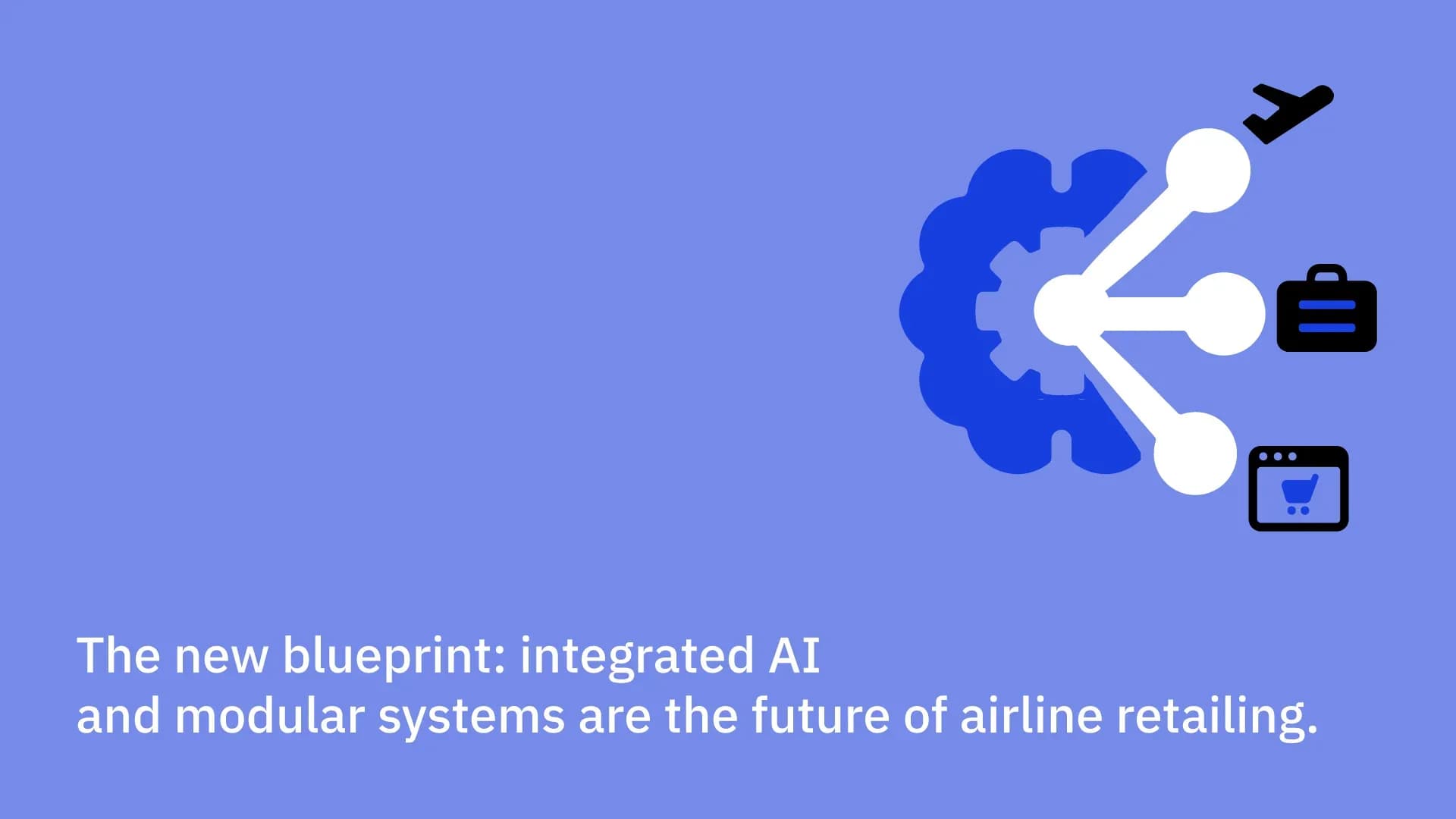
The new blueprint: integrated AI and modular systems are the future of airline retailing.

aviation,
travel,
CX,
AI,
technology,
operations,
digital transformation,
Published on Mon Dec 08 2025
Updated on Mon Dec 08 2025
4 minute read
The consensus is clear: integration is the new advantage in aviation. To realise the ambitious goals of hyper-personalisation and advanced digital retailing, the aviation industry must stop approaching new technologies like siloed projects. Rather, success lies in treating artificial intelligence (AI) and modular systems as interdependent components necessary for a successful transformation.
So, how can this unprecedented level of integration be achieved in a sector as complex as aviation? It’s all about pinpointing the central shifts every business must prioritize. The industry’s new blueprint requires airlines to focus on connecting systems across three core areas: establishing a flexible architecture, leveraging AI for contextual offers, and ensuring seamless customer delivery. Discover the trends and tactics shaping these transformations in practice.
Establishing the modular foundation: ending vendor lock-in.
Entering aviation’s new era of integrated, holistic tech comes with one fundamental requirement: moving from the complex limitations of industry legacy IT systems, which are rigid - and as technical as a medical manual only understood by a PhD - to a modern "offer and order" environment. This user-friendly, flexible framework is essential for facilitating sophisticated, responsive retailing capabilities, such as easily selling a package of goods or managing customer changes, without delays due to tech complexity or even system breakdowns.
To this end, CEOs across various airlines at the World Aviation Festival in Lisbon suggested that a successful transition must be executed on a modular basis, offering critical strategic advantages:
- Avoiding vendor lock-in and enabling best-in-class combos: Modularity ensures airlines are not locked into a single provider. This plug-and-play approach allows them to select the best-in-class components for each function, which is vital for building powerful AI suites that blend highly specialised tools.
- Upgrading and integrating AI-ready solutions: A modular approach should enable newer technology and suppliers to be "plugged in" quickly. Leading partners are actively helping airlines integrate AI-ready solutions into their existing systems, accelerating adoption.
- Facilitating agility and experimentation: To tackle disruption from decarbonisation to personalisation and beyond, the industry needs to be nimble. Modularity supports the need for flexibility, allowing airlines to quickly experiment with new selling methods using an ad hoc approach to respond to geopolitical shifts, regulatory changes, or macroeconomics without being tethered to a restrictive contract with one monolithic vendor.
These benefits are not only compelling - they’ll prove critical as the industry advances. But there’s one crucial prerequisite: making modularity work requires an unwavering, structured-yet-integrated foundation. In particular, airlines will need to develop a robust, modern data architecture that can be scaled effectively based on each use case. Establishing this all effectively puts a set of AI-driven superpowers into airlines’ hands. Let’s explore them in practice.
Leveraging AI for hyper-personalisation: science fiction is now reality.
Once the modular foundation is in place, AI becomes the essential engine for delivering true hyper-personalisation. Over the past 12 months, usage of open systems like ChatGPT has exploded. Now, we are exploring ways to apply LLMs to industry operations to develop cutting-edge services. These include:
- Contextual offers and micro-segmentation: Personalisation relies on robust data lakes to correctly price items and suggest product components. This deep analysis requires micro-segmentation, analysing factors beyond the obvious - such as air merchandise sources, customer profiles, preferences, origin/destination, and travel companions - to create highly tailored offers that boost satisfaction and customer value.
- Dynamic pricing and bundling: AI gives a significant boost to revenue management and offer creation. Where legacy Passenger Service Systems (PSS) are limited, AI enables the creation of an e-retail way of purchasing with precise price points and intelligent bundling.
- Agentic AI for seamless service: We are moving toward agentic AI, which tackles complex, real-life scenarios through specialised, collaborative agents (e.g., booking agents and gate agents). This technology is expected to streamline the retail flow, in part by enabling the quick and seamless sourcing of products and unifying multiple processes within the post-booking window.
The big picture? Customisable, personalised, and optimised aviation retail providing bespoke experiences at a scale previously unimaginable. It’s a shift sure to revolutionize customer experience, offering early adopters a marked advantage before setting an elevated benchmark across the industry. But it’s not without its dangers. It’s time to turn to the implementation practices airlines must balance to make this work.
Strategic implementation and customer delivery: the cool vs. creepy line.
To be truly effective, airlines’ integration of modularity and AI must prioritise customers’ experiences, meeting modern, "Amazon-like" expectations for relevance and ease. Everyone in the industry whom I have spoken to feels nervous but hopeful about the new technology’s capacity to bring this to fruition.
Yet we are still anxious about how AI will change our human behaviour - and this concern isn’t lost on customers. Travellers value fairness, privacy, and autonomy just as much as their convenience. This makes personalised, and even predictive, retail as sensitive in aviation as in any other sector. Leaders must ensure that powerful tech is applied effectively, ethically, and positively. These considerations are key:
- Transparency and trust: As airlines use AI to tailor pricing and offers, they must actively manage the fine line between being "cool and creepy". Building trust requires transparency in how data is gathered, processed, and used. Airlines must be able to explain why an offer is unique to an individual, especially if people travelling together see different prices. This commitment to clear explanation helps ensure that the relevant offer is seen as helpful rather than discriminatory.
- Consistency across touchpoints: True personalisation requires consistency across the entire journey. As one CEO, Cristian Ortiz of LATAM Pass and EVP LATAM Airlines, noted, personalisation achieved in a digital environment (like an app) must be accompanied by personalisation in the physical travel experience (at the airport or onboard), or the effect loses consistency and dissipates.
- Seamless, omnichannel experience: The ultimate goal is a customer-centric model focusing on personalisation delivered at the right time and through the right channel for a frictionless experience. Systems that automatically integrate communications across chat, WhatsApp, email, calls, and beyond help alliances make handling interline journeys into a fluid, convenient process for customers.
Ultimately, balancing personalisation with privacy, consideration, and respect for travellers need not be seen as a tradeoff. Rather, it’s about harmonising the two to achieve a unified, higher aim: seamless customer experiences that offer tangible, true value.
In conclusion.
Flexibility and structure, scale and personalisation, efficiency and empathy - the future of aviation depends on bridging and blending seeming opposites, with AI-powered solutions making what was once impossible not only viable but vital. By implementing modular systems to create a flexible, integrated technological environment, airlines can swiftly adopt and scale AI solutions for dynamic product creation, micro-segmentation, and contextual offers, thereby achieving hyper-personalisation and successfully driving their retailing and ancillary revenue goals.
Whether they succeed is not merely a technical matter, however. No matter how new and exciting the technology, the industry’s task remains the same: delighting travellers with elevated experiences that send loyalty soaring. Ready to lead with the AI-driven CX experts? It’s as simple as partnering with Transcom.
Read more
Created at Fri Oct 09 2026
10 min read
How to measure the ROI of customer experience investments: formulae, steps, and solutions.
Customer satisfaction might be key to long-term business success, but satisfying today’s CFOs and board members to secure the necessary investments takes hard financial evidence. Discover what CX ROI really means in financial terms and why it’s so critical to your bottom line. We break down the four-step framework you’ll need to measure it in practice - from establishing baselines and determining CX levers, to linking them to financial outcomes and calculating net returns. We’l