The hard fact: why plug-and-play modularity is aviation’s only path forward.

travel,
aviation,
CX trends,
trends,
technology,
Published on Mon Jan 19 2026
Updated on Mon Jan 19 2026
3 minute read
A direct flight complete with vegan meals, a quirky hotel in a cultural hotspot, bespoke tours that blend underground gems with unmissable sights - today’s travellers want personalised packages all sorted in a single click. We've talked in previous blogs about how aviation is trading the rigid PNR (Passenger Name Record) system for a flexible, unified "Offer and Order" model that rises to the challenge - but how do we get there without getting completely derailed by the industry’s old, complicated IT systems?
The mantra for airline retailing capabilities has explicitly become "modular". This isn't just a suggestion from a few tech companies; this is a critical issue stressed by industry bodies, including IATA Director General Willie Walsh at the World Aviation Festival in Lisbon. Let’s explore what modular means for airlines and why it means so much to the passengers they depend on pleasing.
Untangling the legacy knot: why going modular is non-negotiable.
Think about trying to rewire an entire skyscraper using only the original 1950s blueprint. Transitioning to the new world of retailing using the airline industry’s complex legacy IT systems is just as frightening - and impossibly tedious. PNR-based systems, with their rigid, dated, and siloed data, simply can't keep up with today's smart approaches that automate the operational slog and generate highly customised offers tailored to each specific customer.
Modularity is the essential solution. It is the required method for transitioning toward the new world, moving away from complex legacy systems with all the restrictions, friction, and confusion they bring. The core strategic reasons behind why Willie Walsh stated modularity has become the mandate are clear:
- Avoiding vendor lock-in: To match the dynamism of traveller demands, the industry needs to escape being tethered to a single provider. Modular systems allow airlines to "choose the best in class" components for every function - it's the only way to ensure quality and flexibility.
- Facilitating innovation: A modular approach enables newer technology to be "plugged in" quickly and smoothly. This flexibility is essential for the industry's progression toward an “Offer and Order environment".
- Integrating AI at pace: Supplier partners like Amazon Web Services (AWS) are working specifically to accelerate this adoption and help airlines integrate AI-ready solutions into existing systems.
By adopting this “plug-and-play” philosophy, the industry will stop building around legacy limitations and start building for exponential innovation - the kind that enhances differentiation through exciting new ways to satisfy customers.
From theory to takeoff: what this looks like in practice.
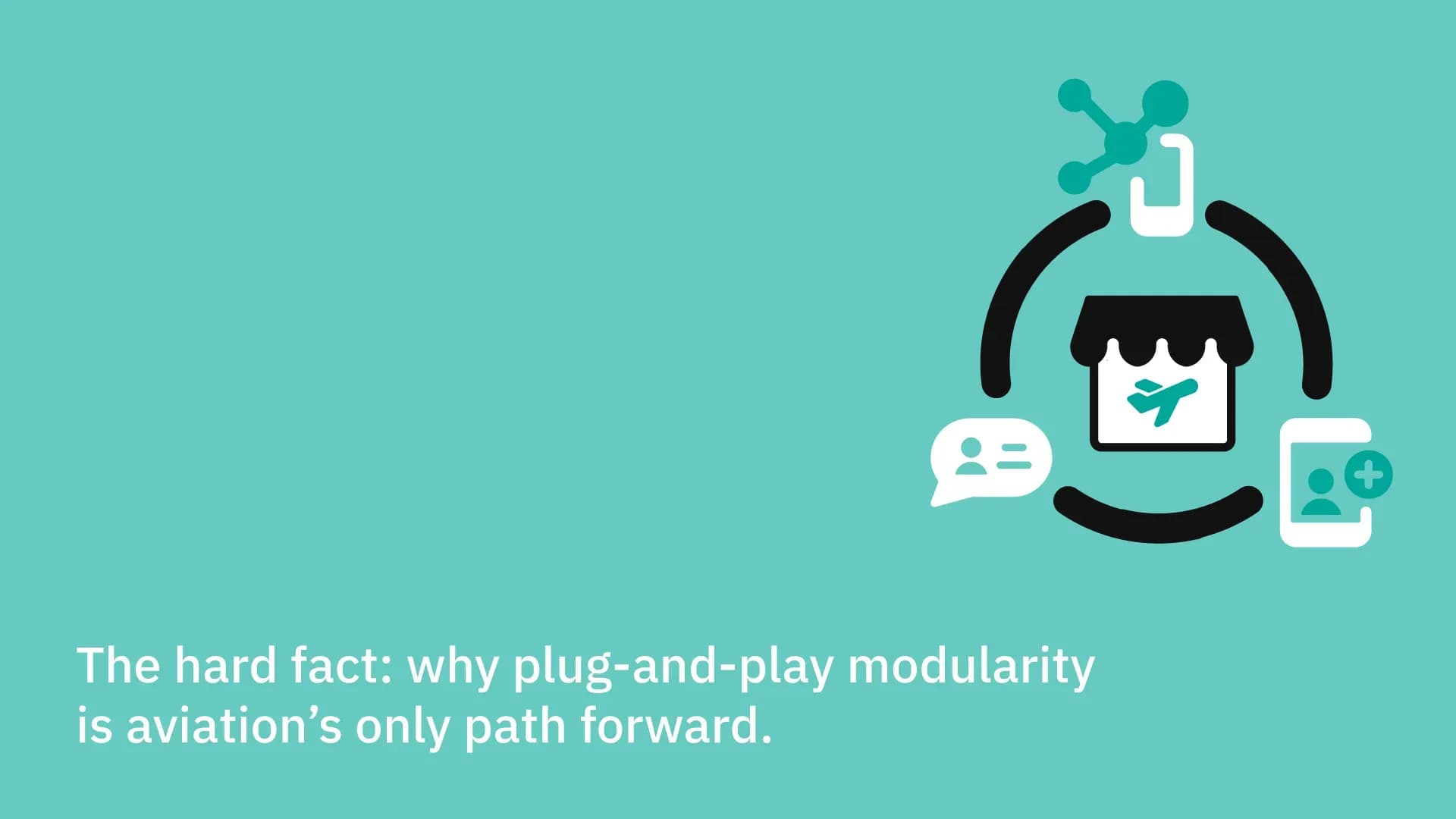
What does this actually look like for the passenger in seat 12A? In a modular world, airlines function less like stuffy rail bureaucrats and more like modern e-commerce giants. Having a tech stack broken up into "plugs” allows an airline to integrate - and remove or replace - everything from a specific travel insurance provider to a local car-sharing or meetup app in weeks rather than years.
For the traveller, this means that their "Order" becomes more than a living document. It’s their convenient, real-time connection to a bundle of personalised services. Need to add a lounge pass or arrange for a hotel spa pass three hours before the flight? In a modular system, these components are updated instantly across the entire chain, turning a rigid transaction into a seamless, responsive relationship with the potential to build loyalty like never before.
In conclusion.
The shift toward modularity isn’t just a technical upgrade. It’s a declaration of independence that frees aviation up to innovate. For decades, the industry’s systems have been defined by what they couldn’t do, grounded by the limitations of the PNR and the gravity of legacy infrastructure. But by embracing a plug-and-play philosophy, airlines are finally reclaiming their autonomy, moving further than ever from the role of ticket seller to become holistic retailers that move at the speed of consumer expectation.
The transition won't happen overnight, but the mandate is clear: evolve or be left on the tarmac. The question for airlines is no longer if they should make the switch, but how fast they can plug into the future. That’s what defines who will fall behind, who will keep up, and who will come out ahead in the race to capture a new generation of wanderlust.
Read more

Created at Fri Oct 09 2026
10 min read
How to measure the ROI of customer experience investments: formulae, steps, and solutions.
Customer satisfaction might be key to long-term business success, but satisfying today’s CFOs and board members to secure the necessary investments takes hard financial evidence. Discover what CX ROI really means in financial terms and why it’s so critical to your bottom line. We break down the four-step framework you’ll need to measure it in practice - from establishing baselines and determining CX levers, to linking them to financial outcomes and calculating net returns. We’l