Outsourced customer care - your success in good hands...

BPO services,
outsourcing,
customer service,
Published on Thu May 15 2025
Updated on Thu Jul 10 2025
7 minute read
Exceptional customer service has become a non-negotiable factor in the success of any business. However, providing top-tier support often comes with a hefty price tag. Staffing, training, and maintaining the necessary infrastructure can quickly strain resources, leaving companies searching for alternative solutions. Outsourcing customer care offers a lifeline, alleviating the financial burden and allowing businesses to redirect their focus towards core competencies. This strategic move not only addresses budgetary concerns but also unlocks the potential for improved service quality, streamlined operations, and ultimately, a more satisfied customer base. By partnering with experienced providers like Transcom, companies can tap into specialized expertise, advanced technologies, and scalable solutions, all while ensuring that their customers receive the care and attention they deserve. Read on to find out how you can have your cake and eat it too.
What is outsourced customer care?
The other option is to hire a professional. Someone with connections and contacts to get the best material at the right price, has decades of experience in planning and building furniture. What took you months is done in weeks or even days, at a fraction of the cost.
This same principle applies to outsourced customer care. It is a business strategy where a company hires an external service provider to handle customer interactions and support functions. BPOs like Transcom specialize in customer service and have the expertise, infrastructure, and technology to manage inquiries, complaints, and other customer-related tasks efficiently. Outsourced customer care can encompass various channels, including phone calls, emails, live chats, social media, and more. By leveraging external resources, businesses can focus on their core competencies while ensuring that their customers receive timely and professional assistance. It might be scary to entrust part of your business to outside help, but in the end you, your clients, and your customers will thank you.
The benefits of outsourced customer care.
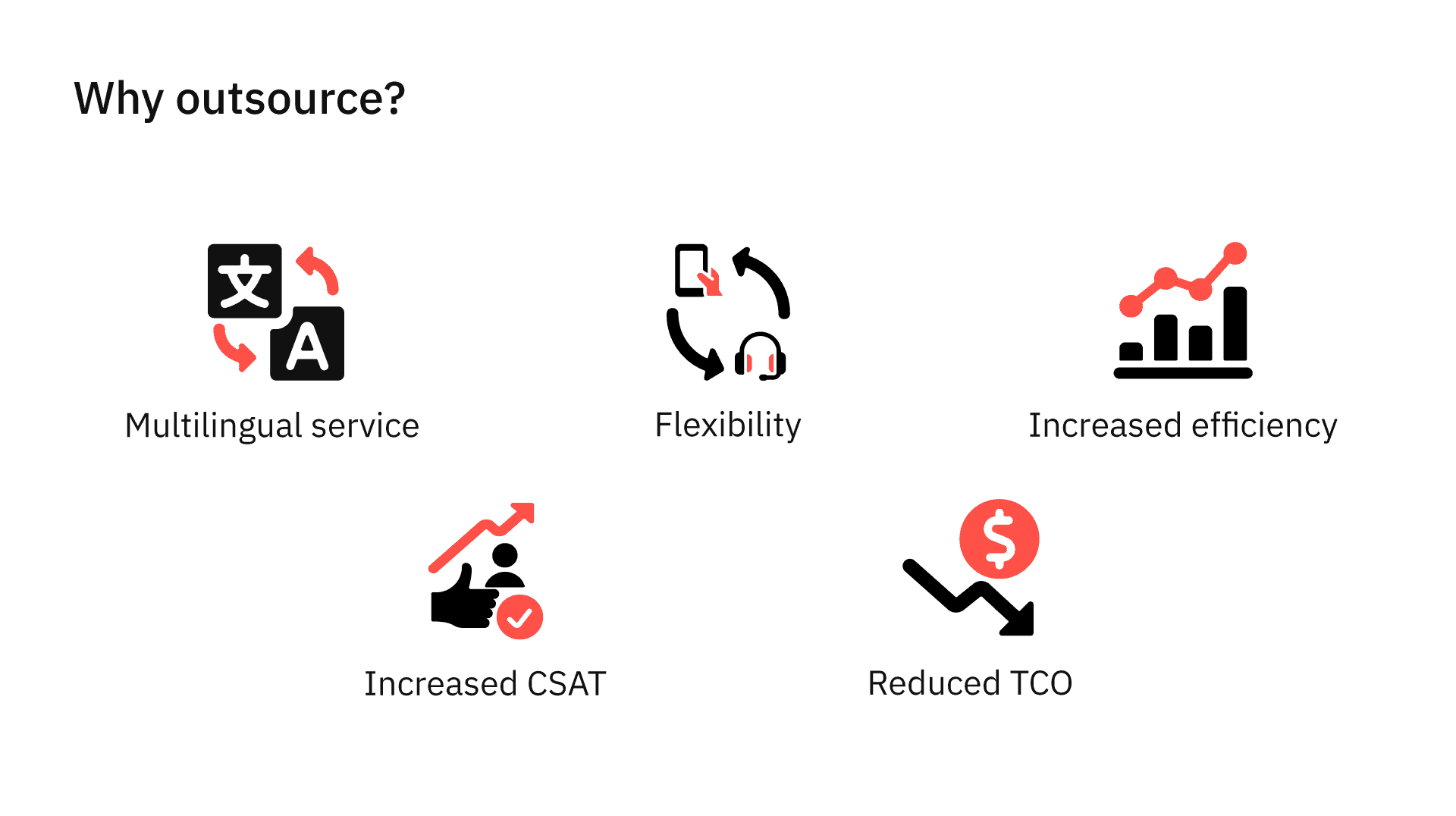
Flexibility.
Outsourcing customer care introduces a significant boost in flexibility for businesses. With an external team handling customer inquiries, companies can effortlessly scale their support operations up or down in response to fluctuating demand. This eliminates the need for rushed hiring or layoffs during peak seasons or unexpected surges in customer inquiries.
BPOs often operate across multiple time zones, ensuring round-the-clock coverage and eliminating the constraints of traditional business hours. Moreover, we can adapt to changing customer preferences by offering support across various channels like phone, email, chat, or social media. This dynamic approach empowers businesses to be more agile and responsive to customer needs, ultimately enhancing the overall customer experience while maintaining efficient operations.
Reduced TCO.
Total Cost of Ownership (TCO) is always a pain point, but it is heavily mitigated by outsourced customer care. By relying on an external provider, companies can eliminate or drastically reduce expenses associated with hiring, training, and maintaining an in-house customer service team. This includes salaries, benefits, office space, hardware, software, and ongoing training costs - not to mention eliminating costs due to inefficiencies.
Outsourcing also eliminates the need for investing in expensive call center infrastructure and technology, as these are typically provided by the service provider. Additionally, outsourced teams often operate in competitive hiring markets, further reducing expenses. By avoiding these substantial upfront and ongoing costs, businesses can achieve a notable decrease in their overall TCO, allowing them to allocate resources more strategically and invest in other critical areas of their operations.
The possible cons and how to deal with them.
Different levels of knowledge access.
Varying levels of knowledge access among outsourced agents can pose a significant challenge. If some agents have limited access to critical information or training, it can lead to inconsistencies in service delivery, miscommunication with customers, and ultimately, customer dissatisfaction. This disparity can also create bottlenecks in workflows, as less informed agents may require more support and supervision, slowing down processes and impacting overall efficiency.
Additionally, inconsistent knowledge levels can hinder problem-solving capabilities, as agents with limited access may struggle to address complex customer inquiries or troubleshoot technical issues effectively. This can lead to prolonged resolution times and potentially escalate customer frustration
At Transcom, we overcome this by using Agent Assist. If our aim is to create superhero agents, then Agent Assist is the trusty sidekick. Connected to knowledge bases, generating real-time automated responses with crucial pieces of information connected to the call, offering next best steps towards resolutions or potential upsells - there’s little that Agent Assist can’t do. All of this means that agents can operate on the same level wherever they are.
Different training standards.
A potential challenge in outsourcing lies in the varying training standards that can exist between your organization and your chosen partner. This disparity can lead to inconsistencies in the quality of service, potentially impacting customer satisfaction and brand perception. Mismatched training methodologies and content can also hinder effective communication and collaboration between your internal teams and the outsourced workforce.
Read more
Created at Fri Oct 09 2026
10 min read
How to measure the ROI of customer experience investments: formulae, steps, and solutions.
Customer satisfaction might be key to long-term business success, but satisfying today’s CFOs and board members to secure the necessary investments takes hard financial evidence. Discover what CX ROI really means in financial terms and why it’s so critical to your bottom line. We break down the four-step framework you’ll need to measure it in practice - from establishing baselines and determining CX levers, to linking them to financial outcomes and calculating net returns. We’l