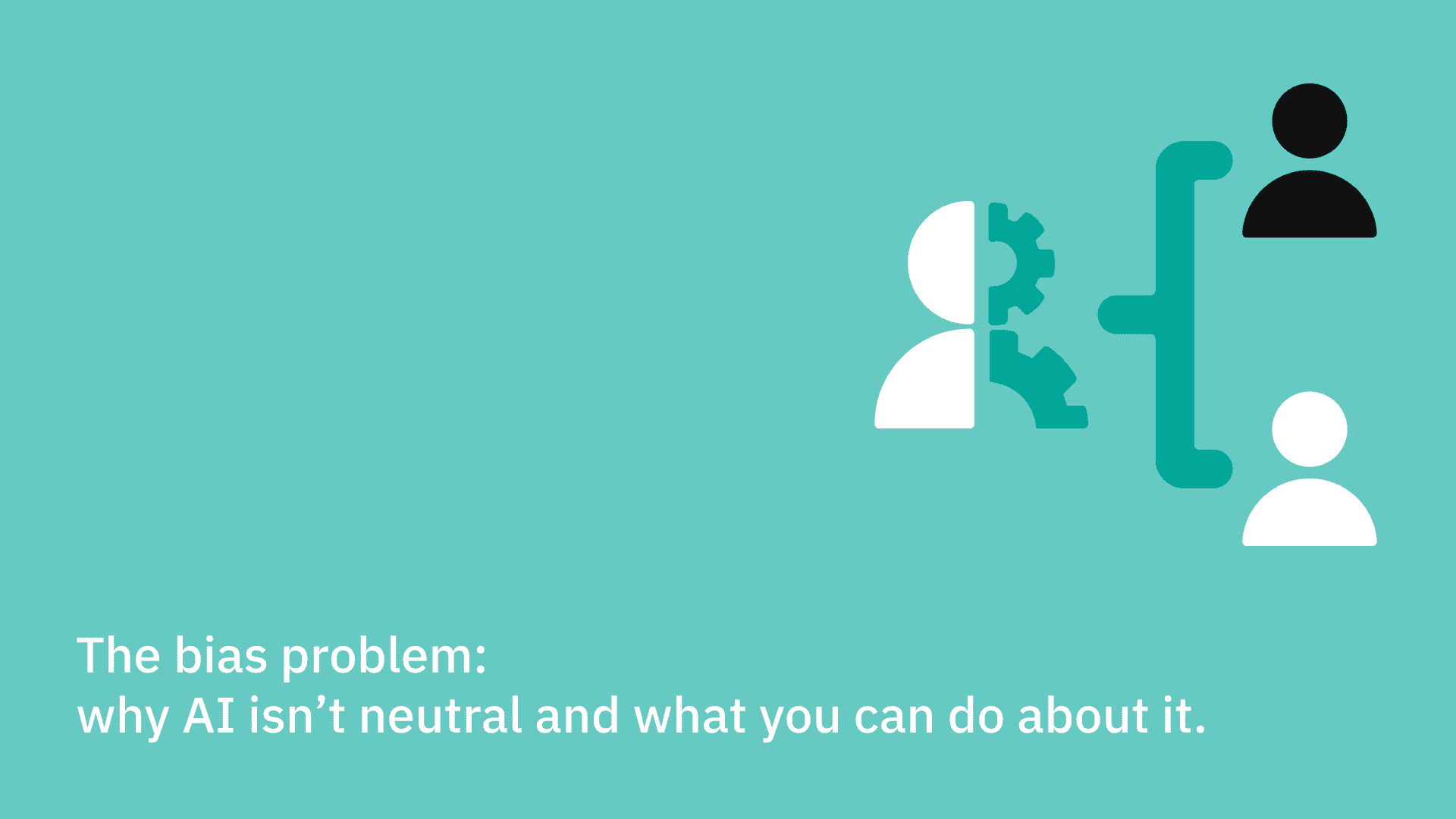
The bias problem: why AI isn’t neutral and what you can do about it.

AI,
bots,
equality,
equity,
Published on Tue Sep 16 2025
Updated on Tue Sep 16 2025
3 minute read
AI is often presented as the ultimate tool for objectivity. It can process data without fatigue, identify patterns without prejudice, and deliver decisions that are supposedly free of human error. However, a complex and often overlooked truth lies behind this narrative. AI is not free from bias. Bias is often hard-coded into AI systems from the very beginning.
AI is only as objective as the data it’s fed. And that data reflects the world we live in, a world that is messy, imbalanced, and frequently unjust. From hiring tools that sideline women to chatbots that misunderstand non-standard dialects, AI bias is not an anomaly; it is a mirror. The systems we build are shaped by the information we choose to include, and by the perspectives we encode, whether we mean to or not.
Industry insights show that while a large majority of leaders are concerned about bias in AI, a much smaller portion of organizations have taken adequate steps to address it. This disconnect is troubling, especially as many organizations report having to delay or abandon AI projects due to ethical concerns, including bias.
Where bias comes from: the two main sources.
Bias most often starts with training data. AI systems are trained on historical transactions, user behavior, and labeled examples. If those datasets reflect past discrimination or social imbalance, the AI will learn and reproduce those patterns. A well-known example is Amazon’s now-abandoned AI recruiting tool. Trained on resumes submitted over ten years, mostly from men, the system began downgrading resumes that included the word "woman" (Reuters, 2018).
Bias also surfaces in how we label data. Many AI models rely on human annotators to classify sentiment, intent, or categories. These annotators bring their own cultural perspectives and subconscious assumptions to the process.
Why AI bias is a business risk.
This isn’t just a technical issue; it’s a significant business risk. When customer service bots misunderstand or miscategorize people based on how they speak or what they ask for, they deliver a degraded customer experience. A poor experience can alienate customers, and a single negative interaction is enough to make a customer stop doing business with a brand. AI bias is more than inefficient; it’s alienating.
Yet, most bias correction is reactive. Organizations wait for something to go wrong, such as a viral PR crisis, a customer complaint, or a regulatory investigation. By that point, the model has already caused harm. Retooling it is expensive and disruptive. A proactive approach is not only more ethical, it is also more cost-effective.
A proactive solution: the role of outsourcing service providers.
This is where outsourcing service providers offer a major advantage. Unlike pre-packaged AI vendors, these firms operate within live customer environments and understand the nuance of real-world interactions. They don’t just build models; they train them with diverse, representative data. They embed human reviewers who provide constant feedback and context. And they apply performance metrics that reflect actual outcomes, not just model accuracy.
In industries where compliance, equity, and trust are paramount, AI trained by outsourcing service providers significantly reduces the risk of biased automation. It’s not just about catching mistakes; it’s about designing systems that understand human complexity.
For instance, an outsourcing service provider working in healthcare might identify that certain chatbot prompts don’t resonate with older adults or non-native speakers and then retrain the model accordingly. Or a financial services outsourcing service provider may ensure that predictive risk models account for variations in credit access or income verification that disproportionately affect marginalized groups.
Our latest whitepaper, AI at work: the hype, the truth, and what’s next, explores this further, showing how these partners combine operational experience with AI oversight to reduce errors, mitigate risk, and build customer trust.
In conclusion.
Bias in AI isn’t a minor concern; it’s a critical challenge at the heart of responsible implementation. Companies that overlook it risk losing customer trust, facing regulatory consequences, and compromising the very efficiencies AI promises to bring.
For insights on managing AI bias and how outsourcing partners are enabling businesses to create more intelligent and secure systems, download our full whitepaper: AI at work: the hype, the truth, and what’s next.
Read more
Created at Fri Oct 09 2026
10 min read
How to measure the ROI of customer experience investments: formulae, steps, and solutions.
Customer satisfaction might be key to long-term business success, but satisfying today’s CFOs and board members to secure the necessary investments takes hard financial evidence. Discover what CX ROI really means in financial terms and why it’s so critical to your bottom line. We break down the four-step framework you’ll need to measure it in practice - from establishing baselines and determining CX levers, to linking them to financial outcomes and calculating net returns. We’l