Published on Thu May 15 2025
Updated on Fri Aug 08 2025
10 minute read
In the modern workplace, the employee is expected to communicate more and more. It can take place between colleagues, superiors, customers, or clients in both written and verbal form. At Transcom, we highly value skilled communicators, which is why today we’ll be exploring the topic of communication and how to improve your skills in the workplace.
While most of us have a general idea of what it could be, or at least what we perceive it to be, because of the complexity of the topic we first need to establish what communication actually is before we continue talking about it. It is any type of giving and receiving information, be it through words, written or spoken, or by other means. This definition will be made even clearer once we quickly go over the types of communication
There are many different forms of communication and equally as many different ways to group them, but for our purposes, these two groups should be enough.
The main three types of communication in linguistics are verbal, paraverbal, and non-verbal. Verbal is the simplest form, in it, we take the words spoken or written at face value. What you mean is what you say. Michael is a very hardworking person.
As previously mentioned, communication in the workplace is becoming extremely important due to the vast amount of different types of conversations one encounters in the workplace. This, combined with the need for speed and accuracy when giving or receiving information, makes effective communicators an important asset for the business. Working at Transcom is a dynamic environment in which you’ll need to communicate in many different ways, which means that we need skilled communicators or people who are willing to actively work on their soft skills.
Next, we’ll give you some practical advice on how to improve your communication skills at work. These tips are mostly concerned with structured speaking, e.g. meetings and presentations, but most of them can also be applied to writing or unstructured speech.

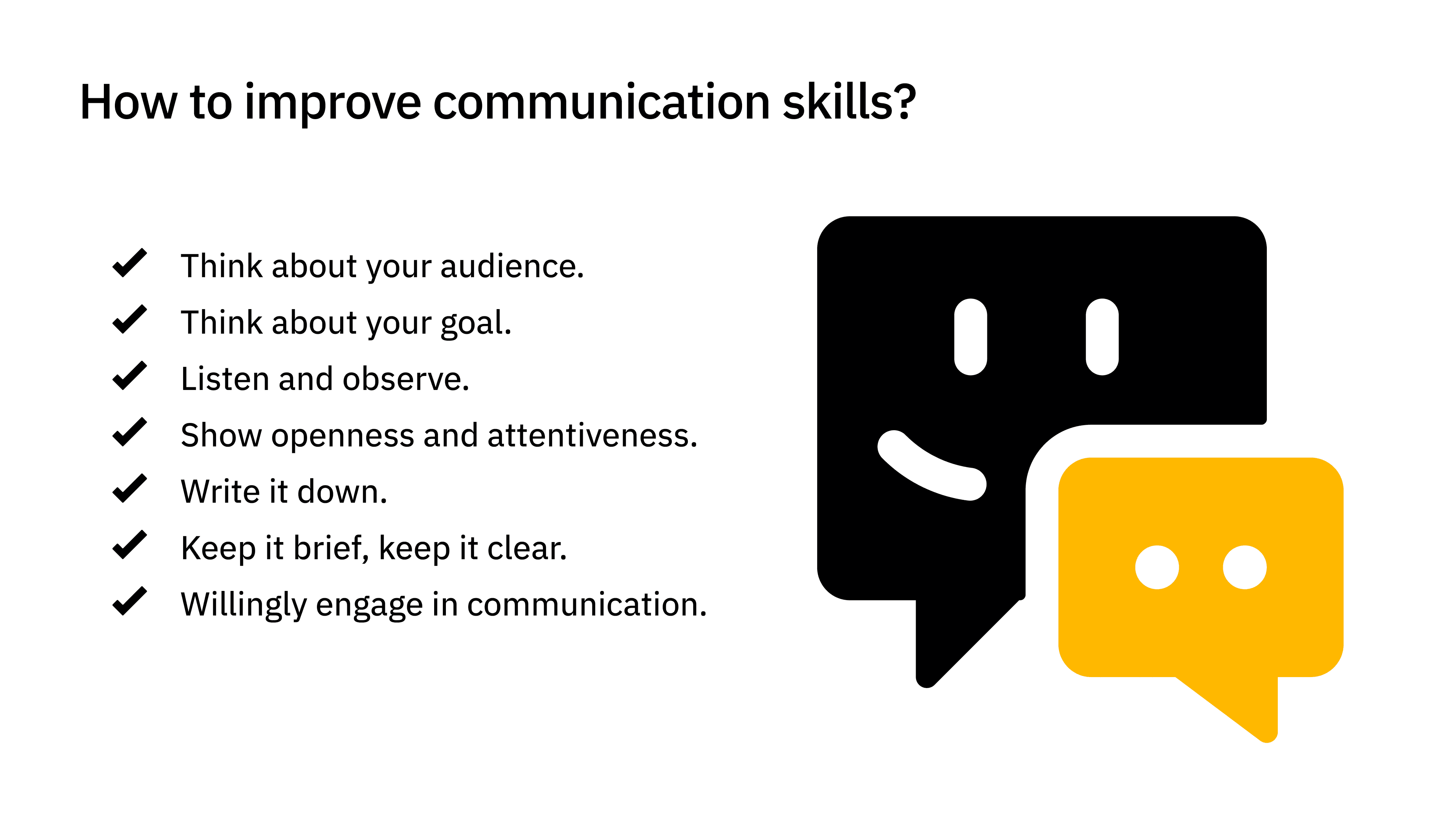
Before you even start thinking about what to say there are a few things you should think about and bear in mind. The first question you should ask yourself is: “Who is my audience?”. You should change the way you communicate depending on who you’re speaking to.
Most people don’t communicate in the same way with a close coworker as they do with a client. Because of that, you need to adjust the tone and formality depending on the situation.
In order to effectively communicate you need to have a general idea of what information you want to get across and also what the point of that information is. If you’re looking to convince a client that they need a certain service you’re going to be formal but may slip into slight informality to emphasize a point. On the other hand, if you’re looking to talk to a colleague about a serious issue you will adopt a more formal tone to accent the gravitas of the situation.
Effective communication isn’t just getting your point across and leaving it at that. Good communicators have a dialogue instead of a monologue, they exchange information instead of simply saying what they have to say.
You have to listen to what the other person or persons have to say. That is the number one trait that people have identified in good communicators. But, going back to what we said about types of communication, listening often isn’t enough. You need to look at the person you’re talking to, observe their gestures, expressions, and body language to get more meaning out of their words. Feeling seen is equally as important in a conversation as being heard.

Created at Fri Mar 27 2026
5 min read
Leaders’ most valuable insights don’t come from their titles. They come from lessons learnt along real professional journeys. That’s the wisdom behind our Leading Voices series charting the careers and challenges of the real pioneers behind the future of customer experience. And there couldn’t be a richer example than the story of Julie ‘Jam’ Barton. With more than 16 years of experience across both client and BPO environments, she now leads global training and communications for member servic
Apart from that, we have the usual division into formal and informal. This is more connected to tone and how we shape our voice and message depending on the situation.
In a more formal setting one tends to avoid contractions, slang or abbreviations, while in an informal setting, you may speak more or less how you like. You still need to pay attention to shaping your speech, depending on the person you’re speaking with.
If you want to have an effective and pleasant conversation you also need to show that you want to talk to a person. This is done in two ways.
The first way is to show openness either through body language if you’re speaking face to face or by emphatically saying that you wish to have a dialogue in written form.
The second is to show attentiveness and this can also be done either by body language or by using phrases or words that show that you’re listening. When using body language you can nod along to what a person is saying but also show empathy by reacting to the information you’re getting. This is called reflective listening and is one of the key traits of a skillful communicator.
The next thing that you can do to improve your communication skills is to simply write things down. This can be especially useful in longer meetings with a lot of people exchanging different types of information.
You can write down what people were saying so that you can mention it or reflect on it later on or you can write down your thoughts so that you know that you wanted to say something about a certain topic. This is also helpful as a preparation before a meeting because you can outline what you want to say in order to exchange information as effectively as possible.
That brings us to the next tip which is concerned with the length of time you speak. The golden rule is to keep things as short as possible while still giving all the information that you need to, while still being clear on what you wanted to say.
It’s easy to have a long speech or presentation because you want to be extra sure that everyone understood what you were saying, but it’s equally easy to overdo it on the editing and end up with a short speech that explains nothing.
The last, and probably the most important, tip on how to improve your communication skills in the workplace is to simply talk. The more you speak with people, the better you get at it. It’s as simple as that.
Talk to your coworkers, and don’t be afraid to do it. Not only does it help with your soft skills but also builds relationships with the people around you.

Created at Tue Mar 17 2026
2 min read
Want next-gen corporate infrastructure that truly works?' Then think of Artificial Intelligence (AI) not as a pretty, design piece of furniture, but as the heartbeat of a modern building - a seismic-resistant, smart system that ensures the entire structure functions intelligently.
Introducing AI into a business without preparing the groundwork is like installing a state-of-the-art elevator in a crumbling building without strengthening the foundations. While the elevator might move quickly, the

Created at Mon Mar 09 2026
4 min read
I can remember when mobile phones became ubiquitous. In the 80s, there were a few early adopters carrying enormous phones around self-consciously, but in the 90s, phones became small enough to fit in your pocket. Companies from my part of the world - such as Nokia and Ericsson - ruled the cellphone market globally. [Now, all those old phones are in museums