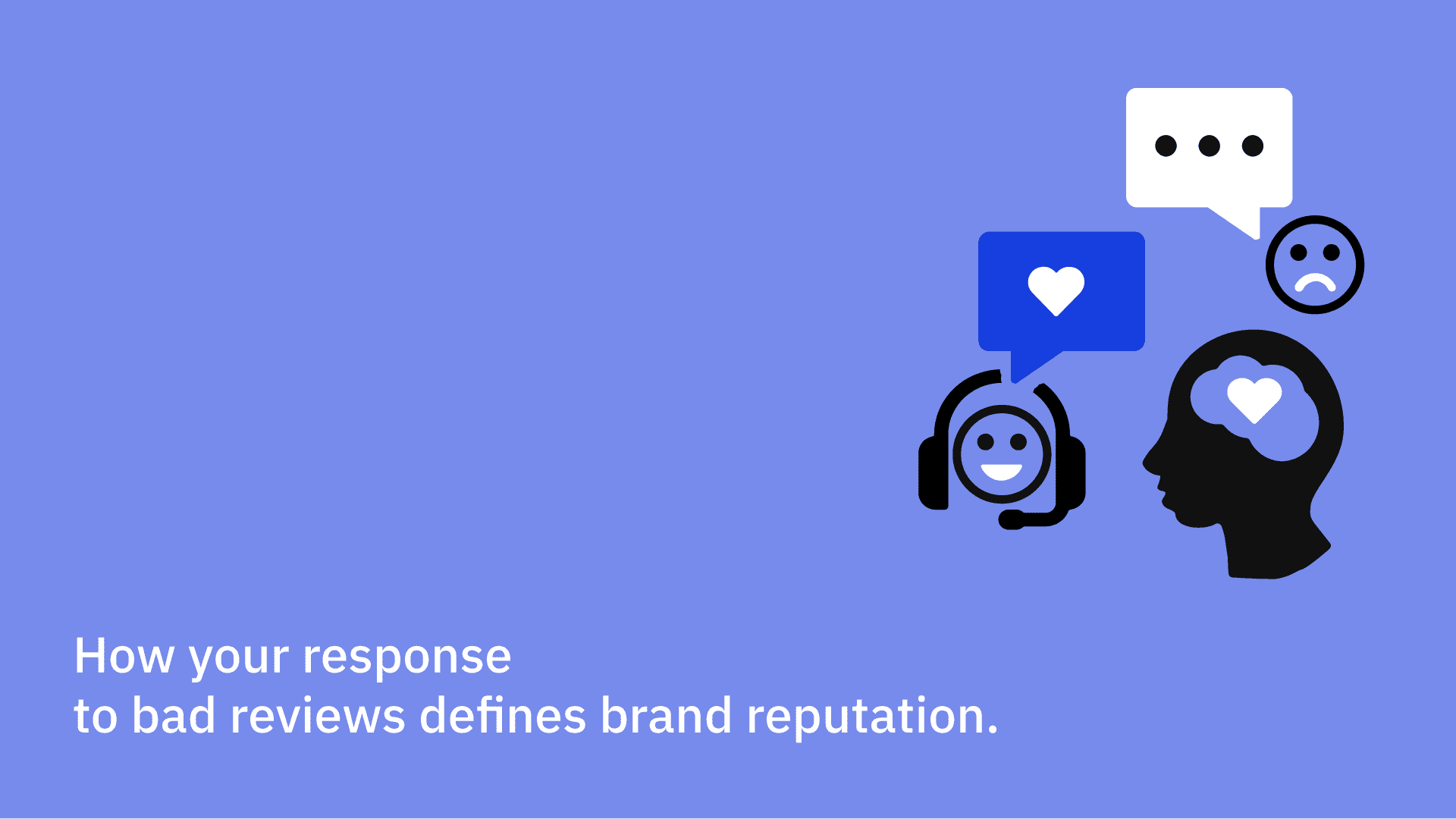
How your response to bad reviews defines brand reputation.

CX,
customer service,
brand reputation,
customer churn,
customer loyalty,
Published on Mon Nov 10 2025
Updated on Fri Nov 14 2025
4 minute read
We’ve all seen them: the scathing one-star review, the angry tweet, the detailed complaint on a brand's social media post. In our hyper-connected world, a negative customer experience can feel like a public relations nightmare unfolding in real-time. Your brand’s first instinct might be to hide, delete, or dismiss it. But what if a bad review isn’t the end of the story, but the beginning of the next big opportunity?
While a negative review can feel like a blow to your reputation, it’s not the critique itself that defines your business. It’s how you respond to it. Market research shows that 91% of consumers check online reviews before making a purchase and 71% are more likely to recommend a business that responds to reviews. Your reply strategy has become a public performance where every potential customer holds a front-row seat. And they're watching closely. Consumers expect a response to negative reviews within a week, with many expecting action within just 48 hours. With feedback shaping customer loyalty more than ever, what are the potential pitfalls, and how can you master the right approach? Let’s look at what to avoid and what to do instead.
The high cost of an automated response.
First, let's take a look at what not to do. Nowadays, the temptation to automate replies at scale is understandable, yet it is also one of the most common mistakes brands make. In reputation management, speed matters, but sincerity matters more. When a response feels robotic or detached, it tells customers their experience was not worth real attention, which can escalate frustration faster than silence.
Recent findings from Birdeye’s State of Online Reviews 2025 show that many U.S. companies are rethinking this approach. While more businesses are responding to customer feedback, many are moving away from automated replies in favor of genuine, human responses. Manual replies climbed to 61% while automated responses declined, reflecting a clear shift toward personalization. Customers today can easily recognize a template, and when they do, they perceive it as indifference.
The data reinforces a growing truth in CX: AI should support empathy, not replace it. Automation helps teams respond faster, but it cannot replicate understanding, accountability, or care. Brands that emphasize personalized communication are seeing stronger loyalty gains because every authentic reply reinforces credibility.
Word-of-mouth is a powerful growth driver.
Social media puts the power to influence the market directly in every customer’s pocket. Shoppers pay close attention to what people say online and how companies respond to both praise and criticism, making every interaction a potential turning point for loyalty.
And today’s customers have higher expectations and more influence than ever. This might sound like bad news when 85% of survey respondents said they have stopped or slowed doing business with a company because of a poor support experience, according to 2025 CX Leaders Trends & Insights. Yet the report also found that 76% of consumers share their positive experiences with others.
These insights reveal that modern word-of-mouth spans the entire customer journey, not just product quality, giving CX teams more room to win customers over. A negative interaction that is resolved with empathy and efficiency can often generate more powerful, authentic advocacy than a flawless transaction. And with today’s supercharged social sharing? This transforms a negative into a powerful, authentic marketing moment. That's the kind of credibility brands can't buy. But what does it take to ace your response?
Converting critics into advocates.
Clearly, a bad review is not the end of the story. It is a chance to prove your brand’s commitment to listening and accountability. And in a world where every response is public, the way a company manages criticism can strengthen - or totally redefine - its reputation. So how can you make sure it’s a win every time?
Effective CX recovery rests on three interconnected practices that turn reactive moments into opportunities for authentic engagement:
Intelligent social listening.
Prevention is always better than cure - and this is no exception. Real-time sentiment analysis captures what customers are feeling across channels, helping teams detect issues before they escalate. Beyond flagging negative mentions, these insights reveal recurring themes and competitive trends that guide data-driven improvements to protect brand credibility and customer trust.
Empowered agent protocols.
Empathy is irreplaceable in CX recovery. Our AI Agent Assist supports frontline teams by surfacing context instantly so agents can focus on empathy instead of searching for information. With clear recovery frameworks and decision authority, agents resolve issues faster and more personally. This balance of human connection and intelligent automation ensures that every response feels genuine and grounded in care.
Seamless public-to-private resolution.
When criticism happens in public, resolution must show both transparency and respect. Acknowledging feedback openly and then transitioning to private channels through integrated Omnichannel Solutions ensures consistency across every touchpoint. Customers see accountability in action, while observers see a brand that listens and responds with care.
Handled with precision and empathy, even the harshest review can become proof of operational maturity and a story of how trust is rebuilt in real time. This is the essence of modern CX recovery, turning a critic’s moment of frustration into a customer’s story of trust.
In conclusion.
Negative feedback is not a threat; it is an opportunity to demonstrate your brand’s values in action. Every review, complaint, or comment offers you the chance to show customers your commitment to empathy, accountability, and improvement. When handled thoughtfully, these interactions do more than repair relationships. They create advocates who trust your brand even more.
By combining intelligent social listening, empowered teams, and authentic communication, companies can transform challenges into opportunities for growth and loyalty. Want more critical insights to elevate your customer experience to the next level? Download our 2025 CX Leaders Trends & Insights report to discover how leveraging feedback can drive growth and build lasting customer trust.
Read more
Created at Fri Oct 09 2026
10 min read
How to measure the ROI of customer experience investments: formulae, steps, and solutions.
Customer satisfaction might be key to long-term business success, but satisfying today’s CFOs and board members to secure the necessary investments takes hard financial evidence. Discover what CX ROI really means in financial terms and why it’s so critical to your bottom line. We break down the four-step framework you’ll need to measure it in practice - from establishing baselines and determining CX levers, to linking them to financial outcomes and calculating net returns. We’l