What is frontline feedback?

people management,
BPO services,
frontline feedback,
Published on Thu May 15 2025
Updated on Fri Aug 08 2025
8 minute read
Businesses like yours can gather valuable feedback and information from a variety of sources, including internal metrics, customer satisfaction surveys, and more. The odds are you’ve been ignoring one key type of feedback all this time: frontline feedback, which has the power to help you streamline and improve your customer experiences across the board.
Frontline feedback explained.
- Comments or complaints from your frontline workers regarding your business operations, working conditions, or customer base’s mindset
- Suggestions from your frontline workers regarding new operations or procedures
- Survey answers from questionnaires handed out to your frontline employees
How is frontline feedback different from other feedback types?
- It comes from your frontline workers, who have first-hand experience regarding things like how your processes work, how your customers respond to changes or products, etc.
- It’s oftentimes subjective and “raw.” It can take skilled analysis to understand the best conclusions to draw from frontline feedback data sets.
Why is frontline feedback important?
Your frontline employees interact with customers all the time.
First, frontline feedback is important because your frontline workers (such as cashiers, janitors, customer support staff, salespeople, etc.) are the ones who interact with your target customer base. You might be very skilled at running your company, but you can’t deny that you handle the majority of the executive tasks. In any given workweek or work month, you may not directly interact with one of your company’s customers at all.
Your frontline employees are different. They interact with your customers 24/7, so they’re in a great position to receive customer feedback directly, as well as understand what your customers like and dislike. That information can be invaluable as you seek to continually curate and improve your CX/customer journeys throughout your organization
Frontline workers experience some similar pain points as customers.
Next, your frontline workers may experience many of the same pain points or friction points as your customers.
For example, say that you roll out a new mobile app that allows customers to redeem loyalty points through your loyalty program for discounts, free shipping, and other perks. There’s just one problem: The mobile app’s interface is unintuitive, and it’s difficult to know how to redeem the loyalty points without an in-depth tutorial.
Your customers know this, but now, luckily, so do your frontline employees. Those frontline employees might have to help those customers redeem their loyalty points at the checkout counter, slowing down the checkout process for everyone else in the store.
When you receive the same feedback from both your customers and your frontline employees, it’s a surefire sign that the feedback is legitimate, and you should take steps to address it ASAP
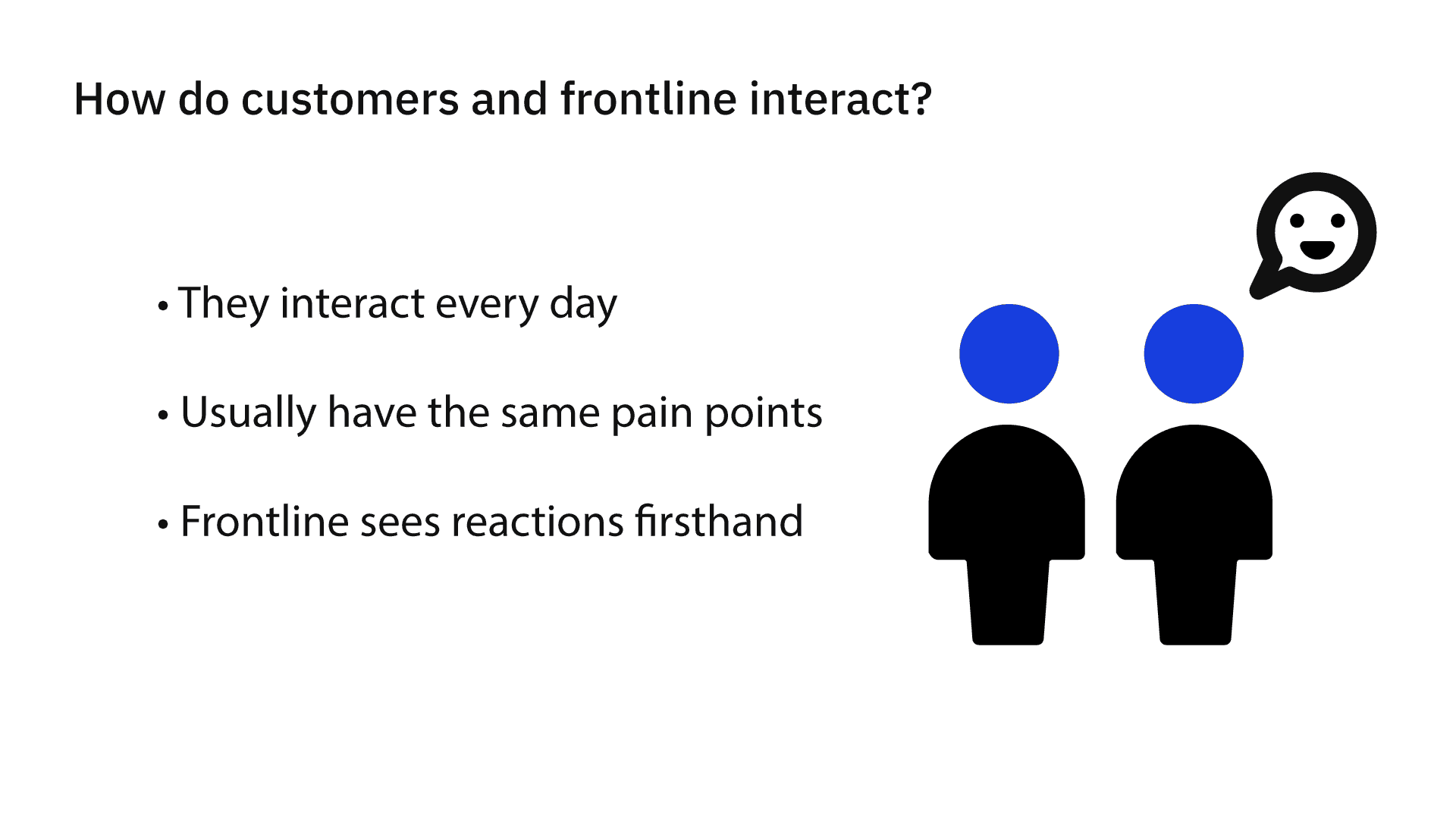
Frontline employees see reactions from customers who don’t respond to surveys.
How to collect frontline feedback.
Ask frontline team members regular questions.
- How have customers responded to our new initiative or products?
- Is there anything you’ve noticed in our customer base over the last few weeks?
- How have certain operations helped or hindered you so you can do the best job possible?
Offer free surveys and incentives.
Maybe you don’t have the time to discuss these things with your workers personally. That’s okay! You can still get frontline feedback by offering free surveys to your frontline employees, like cashiers, salespeople, and more.
How to use frontline feedback.
Identify shared points/reports.
As you look through all of the data you’ve gathered from frontline feedback, like survey responses, letters from your employees, and more, try to identify if there are any shared pain points or points of interest. For example, if all of your survey respondents among your frontline employees say that customers are frustrated with not being able to find specific products, assume that the feedback is legitimate.
Shared pain points or notes of frustration are more than likely accurate, even if your other data doesn’t support the same conclusions. Frontline feedback is valuable because it’s “on the ground” and derived from the most important data source of all: your target customers
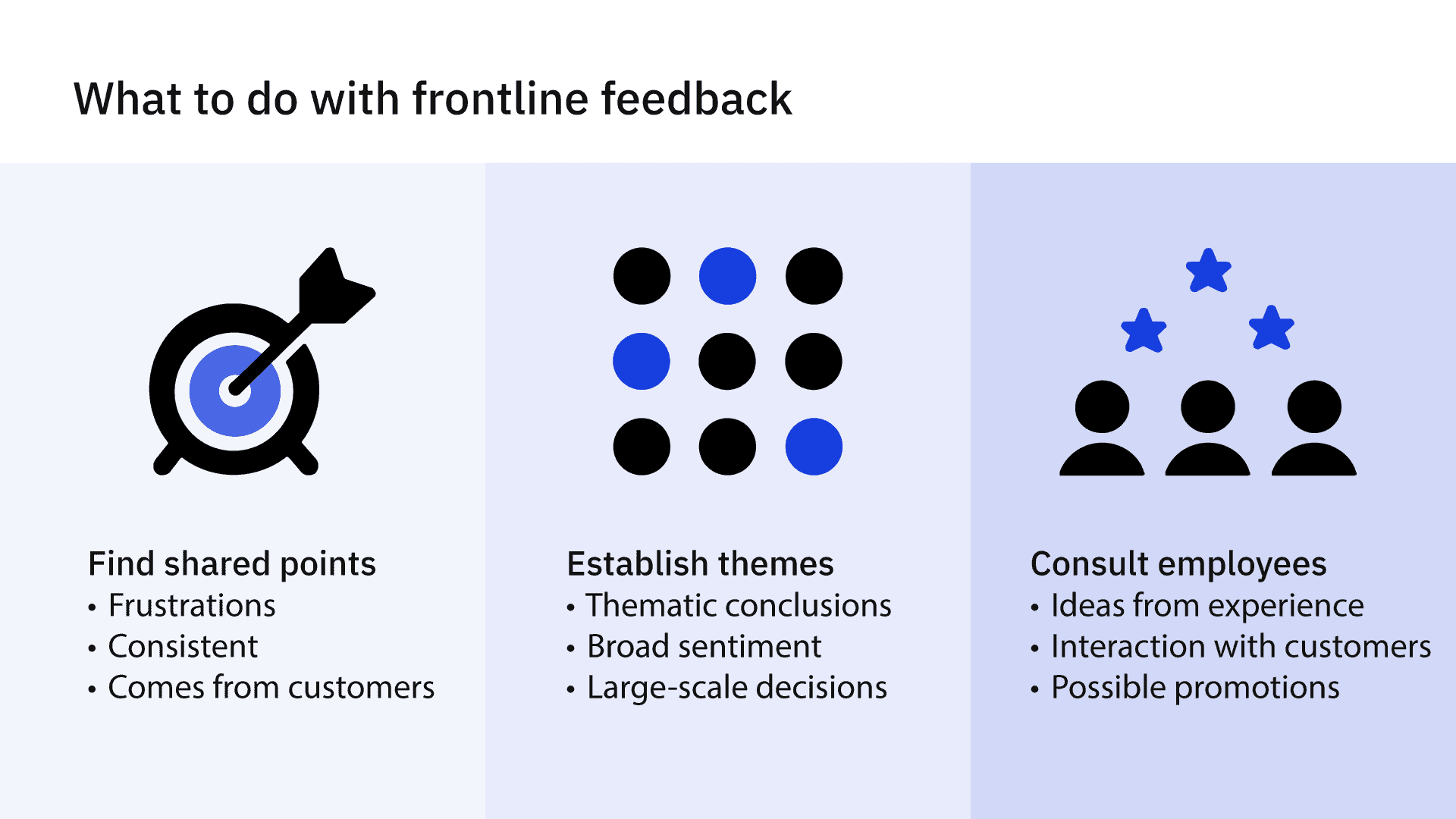
Draw themes from disparate data.
Similarly, try to draw themes or thematic conclusions from all the data you gather. If, for example, your frontline workers note that there has been a rise in customer complaints regarding a specific element of your business, take them seriously.
On the other hand, if frontline feedback is largely positive because of a recent store initiative or new product line, listen to that as well. Themes can help to paint a picture of the overall or broad customer sentiment your brand has cultivated. They’re invaluable when deciding what to do next on a large scale, such as whether to expand, go forward with a new product line, and more.
Ask employees how they’d solve pain points.
Lastly, consider asking your frontline employees themselves how they might solve pain points were they in your position. Your employees, more often than you think, will have ideas about how you can improve things for your customers and their experiences. After all, they have to interact with those customers every day.
Read more
Created at Fri Oct 09 2026
10 min read
How to measure the ROI of customer experience investments: formulae, steps, and solutions.
Customer satisfaction might be key to long-term business success, but satisfying today’s CFOs and board members to secure the necessary investments takes hard financial evidence. Discover what CX ROI really means in financial terms and why it’s so critical to your bottom line. We break down the four-step framework you’ll need to measure it in practice - from establishing baselines and determining CX levers, to linking them to financial outcomes and calculating net returns. We’l