How to evaluate the performance of an outsourced BPO team - your ultimate guide.

CX,
BPO services,
partnership,
performance evaluation,
metrics,
ROI,
Published on Fri Aug 21 2026
Updated on Thu Oct 08 2026
12 minute read
Vast cost savings, an unburdened team, and fuel for your brand’s growth - that’s what handing over non-core business functions to a third-party provider should achieve. But even when SLA compliance looks positive, your outsourcing partnership might actually have the opposite effect. To evaluate the true performance of your BPO team, you’ll need a holistic framework that moves beyond superficial stats to track both quantitative KPIs - such as FCR, CSAT, and agent attrition - across leading and lagging variables alongside qualitative feedback and partnership dynamics. Then, your business must commit to a strict governance rhythm, including monthly and quarterly reviews, and harness AI-powered QA tools to ensure a thorough analysis.
From tailoring a scorecard to your strategic goals with the stats that truly matter to avoiding ‘metric gaming’ - and making sure every insight feeds into continuous joint optimization - here’s your comprehensive guide to assessing BPO vendor performance, spotting and tackling issues before they escalate, and maximizing partnership ROI together.
Establishing a meaningful BPO evaluation framework.
Your business chose a BPO partnership in order to free up resources, from talent to finances, for profit-generating functions - not to shift them towards fruitless data collection or ineffective performance monitoring. But even with the most trusted partner, outsourcing will never be a set-it-and-forget-it task. Balancing efficiency gains with effective governance makes highly targeted BPO evaluation critical for any brand. Failure to do so means defaulting to easy measures or vanity metrics that fail to capture true business value - and often conceal critical red flags.
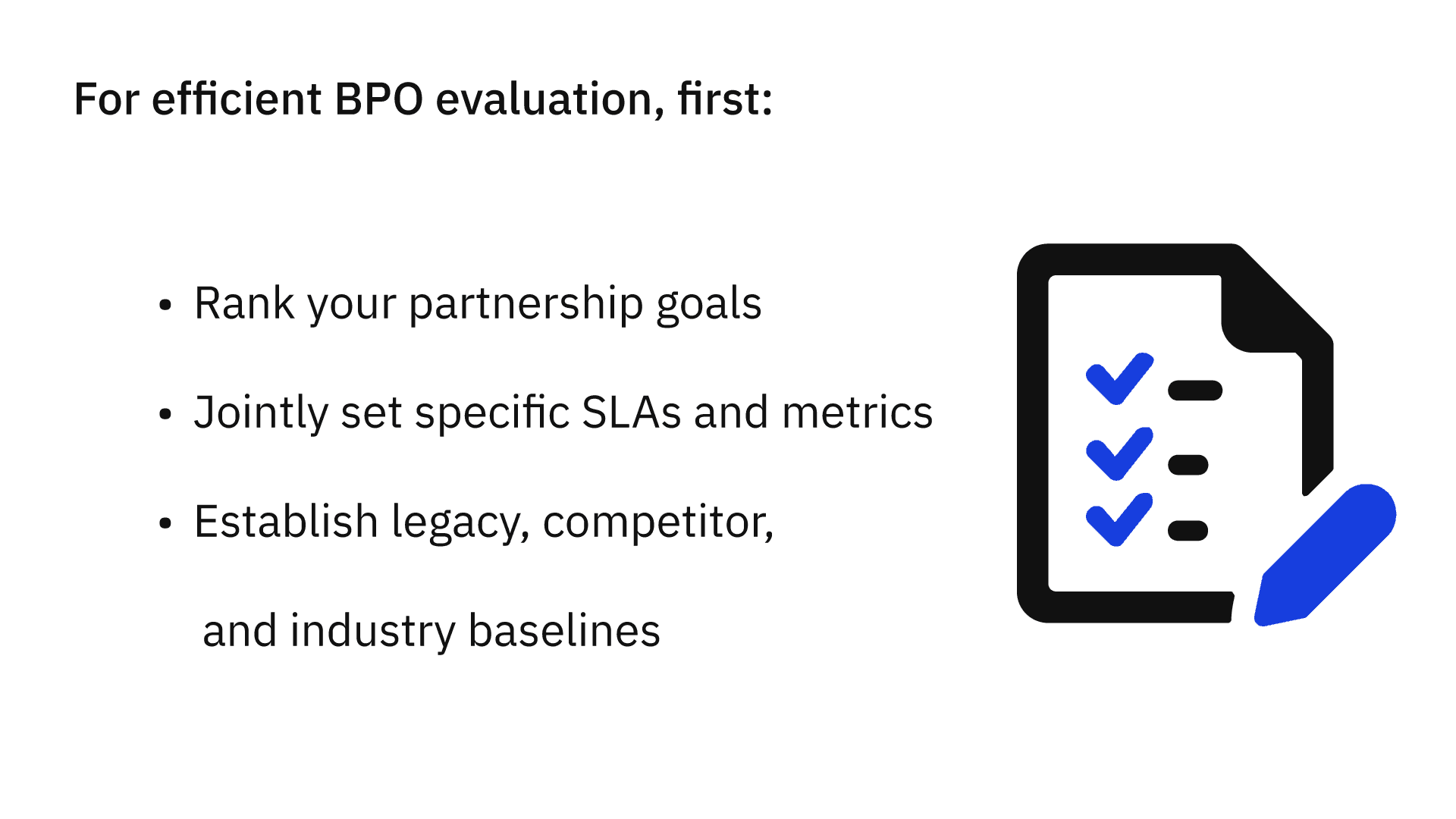
That’s why assessing BPO performance successfully starts with establishing strategic objectives. The best time to clarify your ‘why’ is before your partnership begins. Defining performance is, in fact, your first step when it comes to how to choose a BPO vendor. Make sure to explicitly document your partnership’s objectives and the metrics and data you intend to track in your Service Level Agreement (SLA). It’s also critical to begin with a solid set of baseline figures, be they industry-specific averages or past performance by a prior vendor or your in-house effort. This creates shared accountability and ensures that both your team and your vendor are aligned on the same targets and aiming for the correct concrete results from day one.
To determine your top priorities, ask yourself: is your partnership cost-focused? If savings and efficiency are key goals, your framework must emphasise unit economics and metrics revealing resource utilization. In a CX-focused partnership where brand loyalty is your target, prioritize measures of customer satisfaction and predictors of long-term retention. Strongly regulated industries like healthcare and BFSI may seek compliance-driven BPO providers, insisting on strict SLA adherence rates, data security compliance, and audit metrics. For retail, electronics, and other brands where modernization and a technological advantage are critical, track innovation-focused process improvement proposals, automation adoption, and AI integration, among other indicators. A blend of focuses is typically best to maximise impact for your investment, but ranking your priorities empowers you to create a tailored, weighted scorecard according to what matters most along your brand’s journey - and within its particular niche. Let’s explore the most crucial metrics across all of these considerations.
Building your scorecard: quantitative BPO metrics that matter.
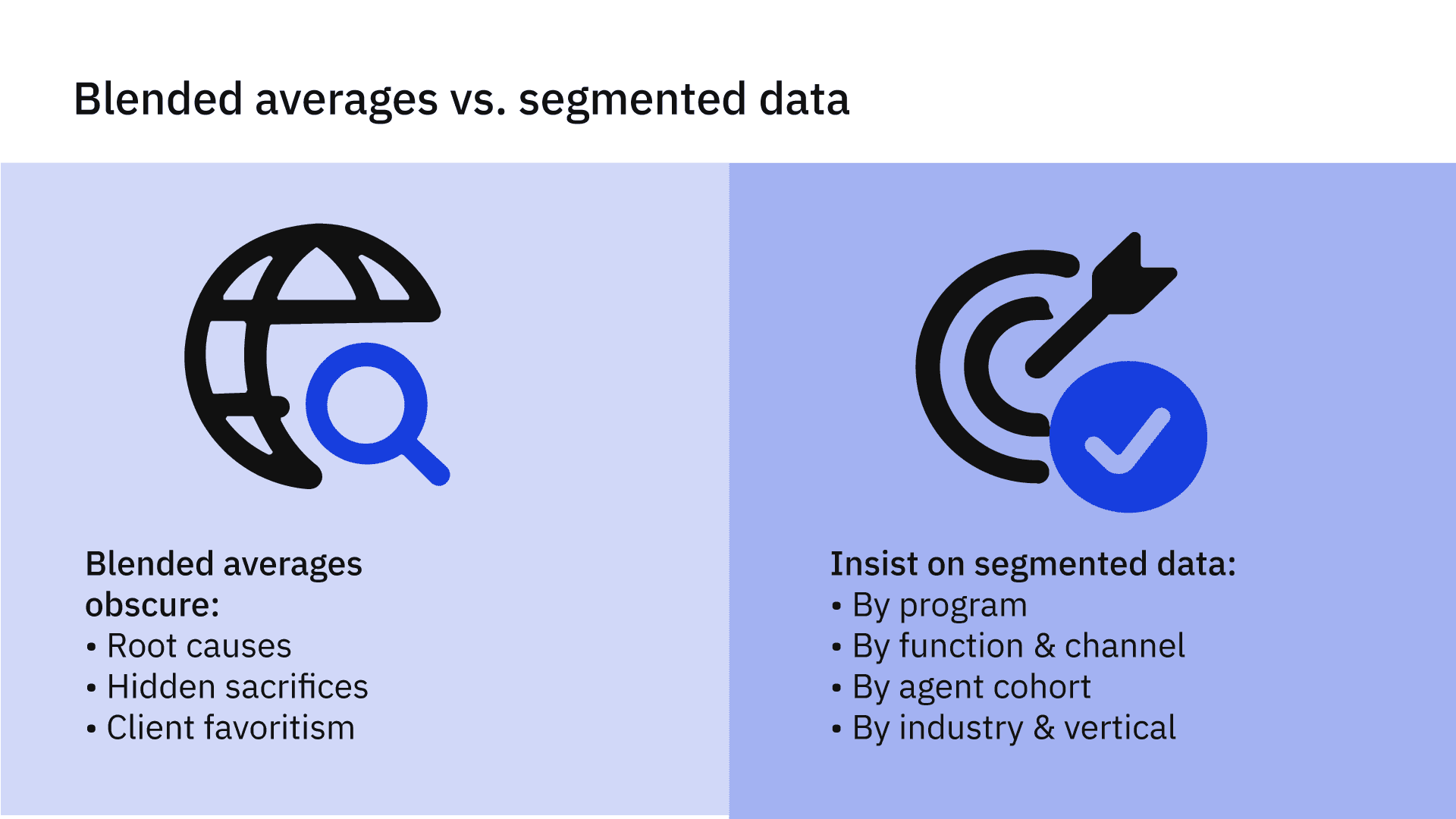
Having established a clear framework of your business’s outsourcing goals, you’ll need to select the right set of metrics to track each targeted priority. Remember that evaluating true BPO performance means not only monitoring the headline stats your SLA makes obvious, but also cross-referencing holistic indicators to make sure there are no hidden sacrifices behind a superficial success. For instance, high customer satisfaction paired with high agent utilization could indicate temporary overperformance with burnout on the horizon.
With this in mind, aim for a balanced scorecard across five distinct quantifiable dimensions:
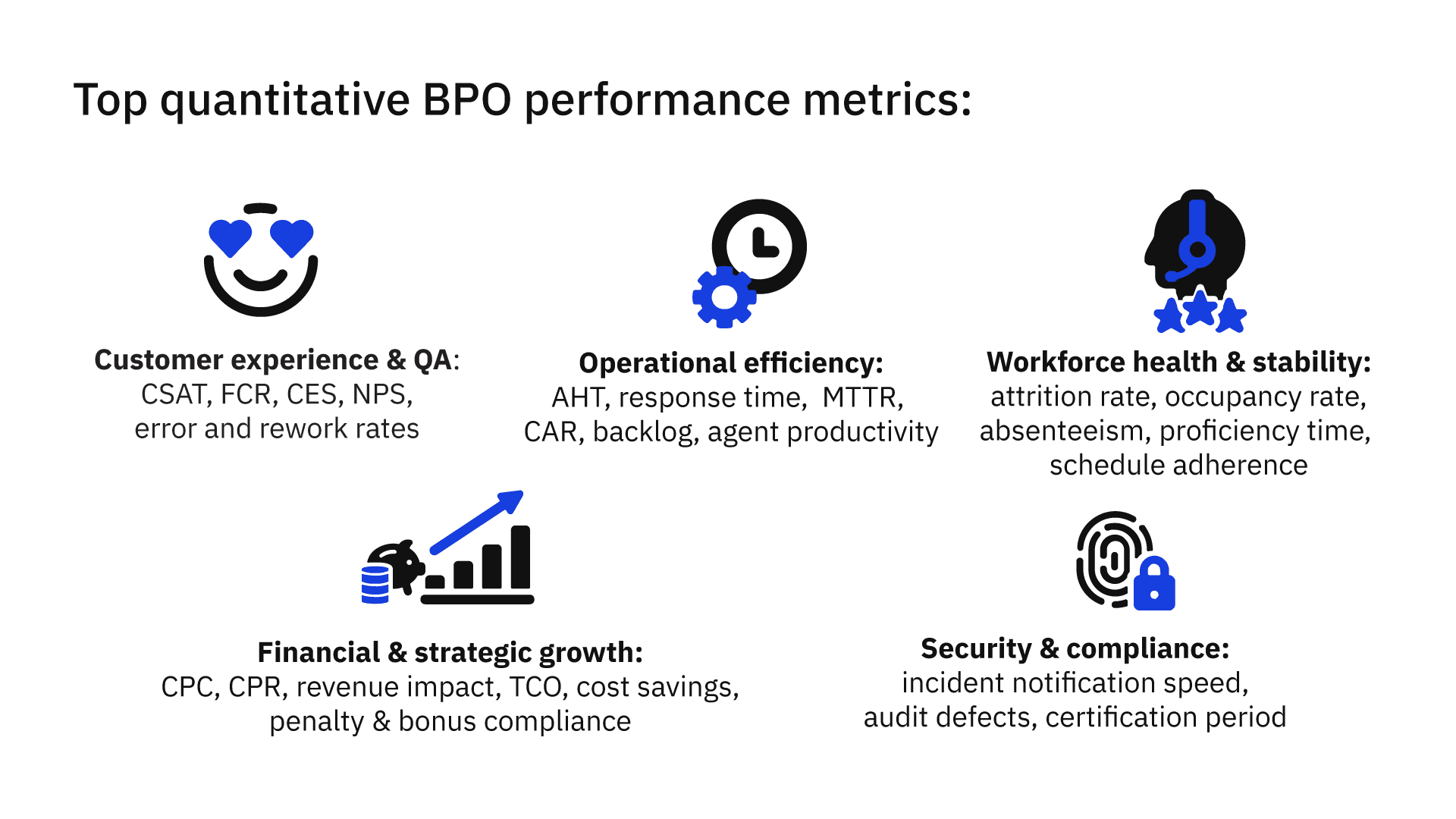
1. Customer experience and quality.
For brands partnering with specialist CX and contact centre providers to gain a boost in loyalty, retention, and customer lifetime value, there’s more to BPO performance and ROI than cost savings. You’ll want to measure:
- First contact resolution (FCR): The percentage of inquiries resolved during a customer’s first interaction with your representatives, be it an email, call, or chat. Aside from boosting operational efficiency, this is the single best predictor of customer satisfaction and downstream churn. A 70-85% FCR is strong across industries, but always check against past performance and real competitors.
- Customer satisfaction (CSAT): Measured through post-interaction surveys, CSAT is a direct rating of customers’ contentment with their experience. Broadly speaking, target 80-90%.
- Net promoter score (NPS): An indicator of long-term loyalty and advocacy driven by strong CX, NPS is calculated as the difference between the percentage of customers who would promote your brand (a 90-100% likelihood of recommending you) versus those who detract from this (0-60% likely to recommend your brand). The result is a score from -100 to 100, with 30-50 considered fair in most industries and 70-100 being exceptional.
- Customer effort score (CES): To measure how easily customers get the support they need, survey users on a 1-to-7 scale where 7 indicates total ease. CES is the average of all numerical responses, or the percentage of customers scoring 5 or higher. Aim for a . For brands in tech, BFSI, and other sectors handling complex inquiries and urgent billing matters, high effort (a low CES grade) strongly predicts customer churn.
Qualitative feedback and partnership monitoring.
Behind every BPO performance metric, there are two teams, yours and theirs, in an ongoing business relationship. Stats are only as reliable - and actionable - as your bond is transparent, proactive, and constructive. That’s why, as critical as your quantitative scorecard may be, it’s just as important to evaluate your BPO’s performance with a few direct qualitative checks and attention to your partner’s behaviour within your dynamic. Critical examples include:
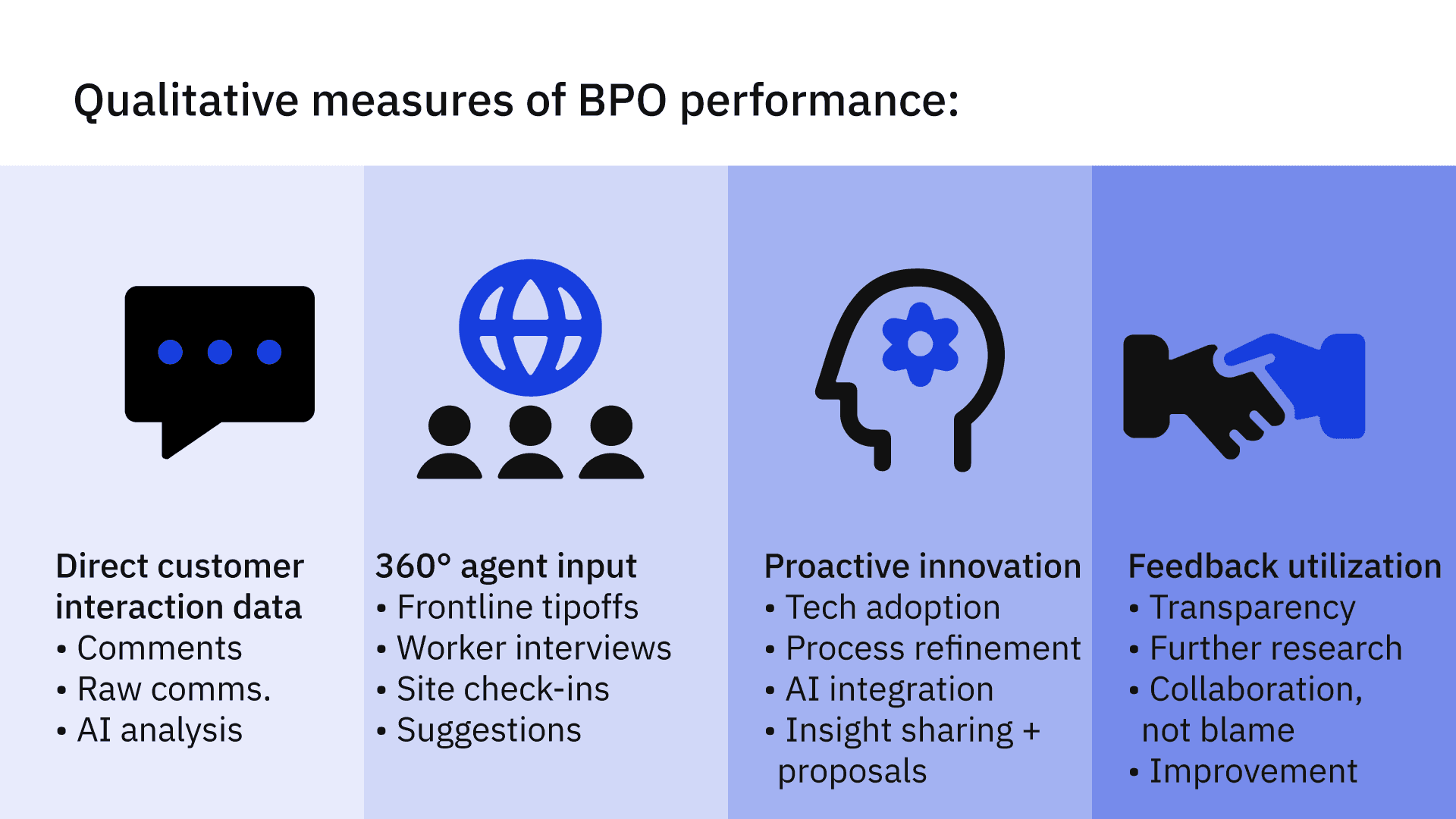
Raw customer comments and AI sentiment analysis.
Request raw customer survey comments and leverage AI-driven sentiment analysis tools to capture emotional nuance, brand alignment, and agent empathy, turning a vast quantity of details into a wealth of hidden insights. This brings the ‘why’ and the feelings behind the scores to the fore with clearer causal links.
360-degree agent feedback.
As with customer data, direct agent feedback is a valuable way to cross-reference and decode data, vet vendor honesty, and gain a full, clear picture of workforce health. Agents interact with your customers, software, and brand reputation every day, so establishing anonymous feedback channels and tracking reports also uncovers broken knowledge bases, clunky tools, confusing internal policies, and hidden friction. Consider it your earliest tipoff - one that arrives even sooner than leading variables hit executive dashboards.
Proactive vendor innovation.
Regularly and consciously evaluate whether your BPO acts as a passive task executor or a true strategic partner. One way is to track the frequency and quality of process improvements, workflow automations, and tech stack optimizations they bring forth independently to your executive reviews. Frequent, high-quality solutions and advancements are a sign of real commitment, a proxy for trust, and an indicator of a sustainable, healthy partnership.
How leaders tackle BPO evaluations: tools, governance, and challenges.
AI is more powerful than ever, but your assessment reports’ rich insights don’t automatically translate into optimisation - yet. You’ll need to establish the right infrastructure to convert analyses into actionable plans, and to ensure that fresh evaluations regularly push enhancements even further. That means replacing outdated manual tracking with modern technology, establishing a strict governance cadence, and proactively defending against common reporting pitfalls. Here is how modern leaders actually execute ongoing evaluation - and harness it for BPO brilliance.
AI-powered tools for efficient, representative data. Relying on legacy manual QA teams to randomly sample two to five percent of customer interactions introduces severe evaluation bias and leaves the vast majority of your operational reality unmonitored. Modern BPO governance demands a centralized technology stack built around AI-driven Conversational Analytics. By deploying tools that automatically assess one hundred percent of omnichannel customer interactions, be they text or voice, leaders extract real-time sentiment scores, flag compliance and script deviations instantly, and eliminate unrepresentative or erroneous manual sampling.
Immediate, shared insight dashboards. To be useful, these insights must be visible. Your partner should transfer them instantly into centralized visualization platforms like Microsoft Power BI, Tableau, or integrated CRM analytics. Agreeing from the outset to operate within your existing technological environment prevents information silos and ensures that both teams are analyzing the exact same live queue metrics and SLA countdowns. Retrospective PDF reporting no longer cuts it. Insist on immediate sharing and operational alignment.
Structured governance and pacing. Evaluations and feedback are a continuous process. To address leading concerns - like mounting ticket backlogs, poor schedule adherence, or AHT fluctuation - that threaten SLAs down the line, as well as any urgent crises, mandate daily and weekly syncs between your internal managers and BPO floor supervisors. More thorough, monthly operational reviews should also be included in your governance framework to detect and discuss broader programmatic trends, QA scorecard anomalies, and the execution milestones of active Corrective Action Plans (CAPs). Finally, anchor the partnership with Quarterly Business Reviews (QBRs) - executive-level summits that bypass daily firefighting to evaluate macro Total Cost of Ownership (TCO), year-over-year cost-per-resolution trends, cybersecurity audit results, and vendor-proposed co-innovation initiatives that future-proof your relationship.
In conclusion.
Evaluating an outsourced BPO team is far more complex than checking a monthly SLA report. It takes ongoing, strategic discipline across rigorous quantitative measurement and deep qualitative insight. But by building a balanced scorecard that pairs lagging operational outcomes with leading workforce indicators, segmenting your data to uncover hidden friction, and backing it all up with AI-powered transparency and a structured governance rhythm, you transform vendor oversight into genuine collaboration.
Ultimately, the goal of this comprehensive framework is not to penalize a partner for missed metrics, but to build a proactive, continuous optimization engine. When you and your BPO provider share a single source of truth and a mutual commitment to improvement, your outsourced operations cease to be a mere cost-saving measure and become a powerful, integrated catalyst for your brand’s long-term success - one that moves towards smoother self-governance and greater ROI each year. Ready to discover what a dedicated BPO expert can do for your team? Contact Transcom today.
Read more
Created at Fri Oct 09 2026
10 min read
How to measure the ROI of customer experience investments: formulae, steps, and solutions.
Customer satisfaction might be key to long-term business success, but satisfying today’s CFOs and board members to secure the necessary investments takes hard financial evidence. Discover what CX ROI really means in financial terms and why it’s so critical to your bottom line. We break down the four-step framework you’ll need to measure it in practice - from establishing baselines and determining CX levers, to linking them to financial outcomes and calculating net returns. We’l