How to choose the right BPO partner.

BPO services,
CX,
partnership,
outsourcing,
customer service,
operations,
Published on Fri Jul 24 2026
Updated on Fri Oct 09 2026
5 minute read
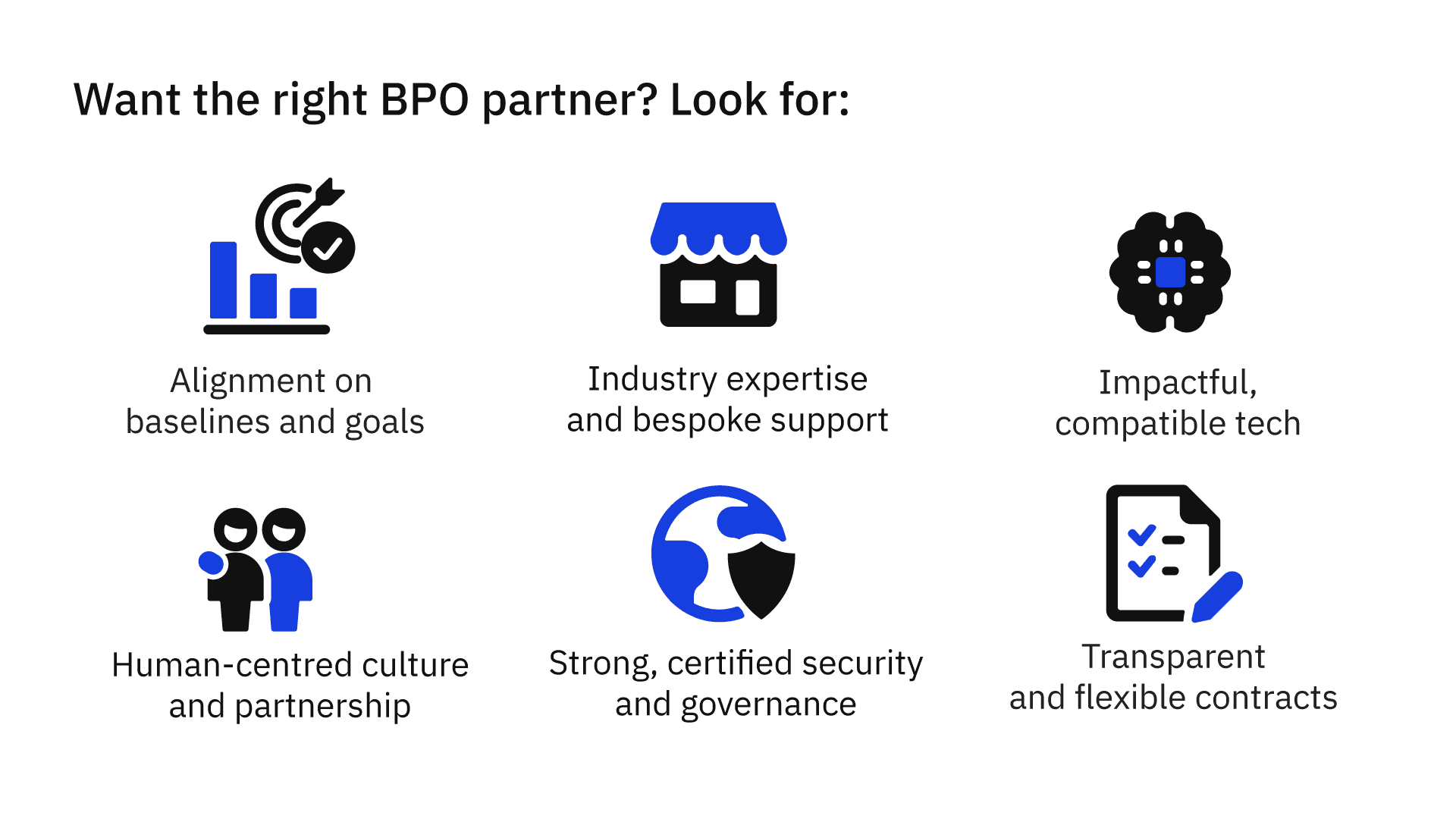
Choosing the right BPO partner requires clearly defining your internal objectives to align with a vendor offering proven industry expertise, verifiable security credentials like SOC 2 and ISO 27001, and outcome-based SLAs. To truly fuel - rather than detract from - your profit-generating core, avoid bottom-of-the-barrel hourly rates and instead target a transparent, performance-driven provider that combines impactful innovation with a human-centric culture to deliver a value advantage beyond optimized cost. Here’s how.
Measure your baselines and set goals.
A measurably successful BPO partnership depends on recording precise baselines and defining specific, quantifiable targets. First, internally prepare by documenting your current performance metrics such as AHT (average handle time) and NPS (net promoter score) and mapping out your typical customer journey, and escalation path. Identify your greatest challenges and articulate what success looks like in 6 to 12 months, whether that’s reducing costs by 30% or boosting CSAT (customer satisfaction) to 90% or more.
One crucial aspect is determining your ideal location strategy: onshore for seamless collaboration and cultural fit, nearshore to balance these with budget considerations, or an offshore hub that maximizes the benefits of cost savings across high-volume interactions. Consider existing priorities as well as your long-term vision, especially global or regional growth ambitions. For 24/7 support and multilingual excellence, choose providers offering custom, scalable networks.
Verify industry expertise and bespoke support.
Reject BPOs offering cookie-cutter approaches that cause costly errors and wasted investments. Awards give you a clue of overall quality, but insist on case studies and 3+ client references proving success with brands that match your size and sector. Domain familiarity reduces onboarding time by weeks, prevents compliance crises, and secures strategies aligned with market dynamics. For instance, vendors with existing healthcare clients have strict HIPAA adherence covered, while eCommerce specialists know how to tackle 50% Black Friday spikes without permanent headcount inflation. Assess service depth and structure. Beyond tier 1 (basic inquiries) and tier 2 (escalations), for instance, SaaS vendors need stellar tier 3 (tech) support.
Even industry experts can’t provide one-size solutions. Look for a vendor that acts as a strategic advisor - one that asks detailed questions about where your current customer journey breaks down and uses those insights to engineer a tailored, high-touch support infrastructure. This should include a structured, personalized transition plan for a smooth takeover.
Seek impactful innovation and tech stack compatibility.
The wrong partner wastes funds and generates frustration chasing tech fads that clash with customers’ needs and create operational friction. Look instead for a BPO that runs contained pilots before rollout and maximizes tech where it matters: seamless omnichannel support spanning calls, text, video, and socials, automated ticket routing that eliminates repetition, QA copilots for real-time performance monitoring, and accelerated agent development with live AI feedback.
Their proven tech should also merge with your current setup. Demand seamless integration with your CRM - be it Salesforce, Zendesk or HubSpot - or a smooth, speedy pathway transition towards tech stack compatibility with explicit uptime guarantees, clear API capabilities, and no hidden costs.
Ensure robust security, crisis management, and governance.
For a resilient BPO partnership you won’t regret, vet how your partner prepares for the worst. First, check out their certifications and specs for evidence of proactively secure operations. Demand proof of SOC 2 and ISO 27001 for customer data security. Look for AES-256 encryption as well as strict, documented data protocols. Full compliance with GDPR or regionally relevant privacy legislation is non-negotiable, as is alignment with industry standards like healthcare’s HIPAA or BFSI’s PCI DSS.
You’ll also need to know how they handle critical situations in real-time. Examine their crisis management approach for clear escalation procedures with named contacts and specified response times according to severity level. Make sure you’re always informed and in control, insisting on governance rights including 24-hour incident notification, spontaneous security audits, and regular monthly / quarterly reviews. Your contract should clearly and fairly stipulate liability and recourse, as well as a smooth termination strategy with full, fee-free data transfer or deletion. This way, you’re covered, whether threat comes from a breach, a natural disaster, or your vendor itself.
Vet for a human-centred work culture and true partnership.
A BPO provider that transcends cost cutting and puts human expertise first gives you a rare advantage. To distinguish between volume-pushers and modern, customer-centric CX partners, examine their culture. You don’t want your customers interacting with a rotating cast of new hires. You want expert agents that receive favourable wages, at least 2-4 weeks of robust training, tech and managerial support to foster confidence, and ongoing development and progression opportunities. Look for annual attrition rates well below the industry average of 30-40%, ideally under 20%, assess their response to a short-notice site visit request, and consider calling customer service anonymously to get a read on agents’ real engagement.
A good BPO's attitude towards agents and partners should tally. Do they sublease to third parties or truly care for all aspects of their work? Do they communicate clearly and reassuringly with you, providing after-hours channels for emergencies? Will they encourage your staff through transitions? Will they proactively feed strategic insights back to you from the frontlines, acting as an advisory to take your business higher? A low client-to-CX-manager ratio is another positive sign. A BPO with the time and enthusiasm to truly care for each teammate and partner will do the same with your customers.
Assess pricing transparency and SLA flexibility, considering a pilot.
Value over cost doesn’t mean that budgetability and service flexibility aren’t crucial. Don’t fixate on the lowest price per hour. Do seek transparent pricing structures where spend maps clearly onto results. Per FTE (full-time employee) and per ticket are common. Leading providers also offer innovative outcome-based models that bring you closer to paying only for real impact, with penalties for underperforming and bonuses for exceeding targets across FCR, AHT, NPS, and CSAT. Models aside, always evaluate Total Cost of Ownership (TCO), anticipating hidden fees like per-minute overages, CRM integration costs, and QA overhead. Transition periods are also costly. Never trust providers who rush onboarding. Budget for reduced productivity during onboarding - at least 4-6 weeks below 100% capacity.
Beyond transparency, you need a partner that grows with you, enhancing - not penalizing - your dynamism. Contract flexibility is key. Make room for evolving SLAs and headcount that scales in both directions without absurd penalties while avoiding rigid, 36-month lock-ins. A 12-month contract with terms for convenience and an exit notice period of 90 days maximum is fair. For extra certainty, never sign without running a 1-3 month (e.g. 200-hour) pilot project. There’s no better way to test performance, communication efficiency, QA processes, and the reality of partnership before committing long term.
In conclusion.
Ultimately, your best BPO partnership comes from prioritizing long-term value and true collaboration over bottom-tier cost savings. This starts with knowing your internal baselines and demanding niche expertise to avoid the costly friction of generic solutions. Beyond a strong track record and certifiable security and compliance, ensure that your vendor balances prudent technological innovation with a human-centric culture, keeping agent attrition low and engagement high.
Insist on transparent, outcome-based pricing and flexible contracts. With patient vetting and a live pilot, you can secure an outsourcing partner that doesn't cut overhead while concealing crises, but seamlessly extends your business and actively fuels sustainable growth. Ready to level up with a relentlessly committed BPO partner? Contact Transcom’s team today.
Read more
Created at Fri Oct 09 2026
10 min read
How to measure the ROI of customer experience investments: formulae, steps, and solutions.
Customer satisfaction might be key to long-term business success, but satisfying today’s CFOs and board members to secure the necessary investments takes hard financial evidence. Discover what CX ROI really means in financial terms and why it’s so critical to your bottom line. We break down the four-step framework you’ll need to measure it in practice - from establishing baselines and determining CX levers, to linking them to financial outcomes and calculating net returns. We’l