What are the benefits of offshore BPO? Your practical guide.

BPO services,
business process outsourcing,
offshore,
outsourcing,
Published on Mon Aug 10 2026
Updated on Wed Sep 16 2026
10 minute read
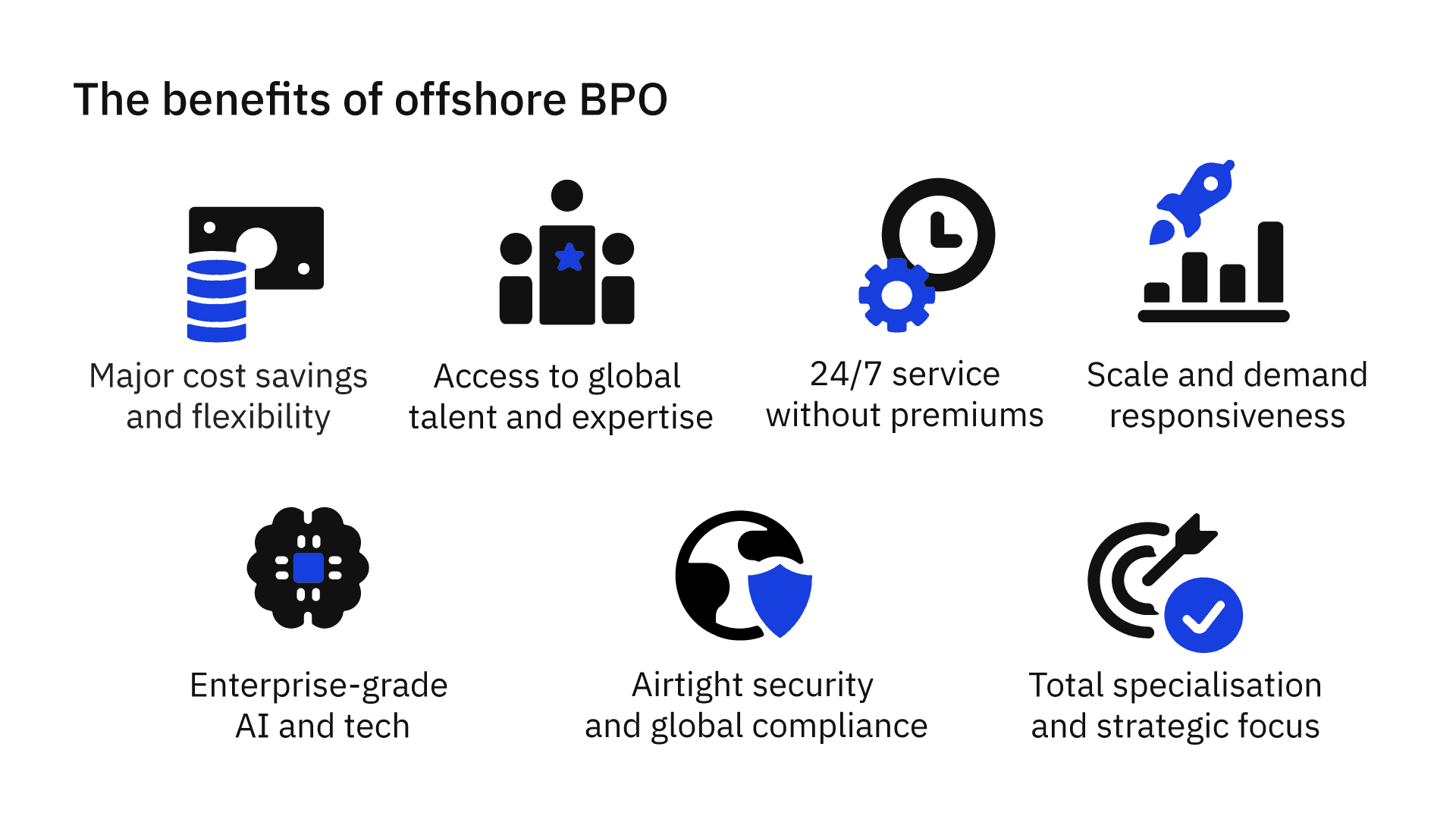
Cutting costs by 40% to 70%, achieving 24/7 service coverage, and accessing a vast global talent pool of skilled workers are just a few reasons why offshore business process outsourcing (BPO) could be your company’s next competitive advantage. Strategic benefits ranging from enterprise-grade tech to airtight security - all financed flexibility without steep upfront investments - are driving businesses of every scale to delegate more non-core functions to overseas providers. But doing so is not without risks. Discover the advantages offshore BPO can offer your brand, which industries benefit most, what location strategy suits your business, and how to mitigate threats and maximize your partnership’s value.
Offshore BPO’s core benefits.
Brands that outsource non-core business processes to third party providers in distant countries - a strategy known as ‘offshoring’ or ‘farshoring’ - do so based on substantial gains. These must be compelling enough to outweigh any corresponding loss of direct control, perceived or real, as well as other key risks. So, what are the benefits?
1. Major cost reductions and TCO optimization.
Drastically cutting costs is the most common reason companies choose offshore BPO. Compared to building the same capacities in-house, offshore outsourcing saves you between 40 and 70% of labor and operational costs. Labor arbitrage - hiring in regions like India and the Philippines where wages and cost of living are structurally lower - is one core factor behind this. Governments in these regions also offer BPO providers perks like tax incentives and relaxed regulations to support the industry, and these too are passed on to your business via favourable prices.
But the financial benefits - whether based on your partner’s location or their specialization and returns to scale - go further. BPO outsourcing replaces a complex set of unpredictable costs, including high capital expenses that act as barriers to entry, with predictable, flexible monthly pricing. Recruitment, baseline salaries, benefits, employer taxes, real estate, hardware, utilities, tech, and HR expenses are typically handled by your provider as part of the package. Your business simply pays per FTE (full-time employee), per ticket, or as specified in your contract.
By function, the largest savings are for back-office and data entry, where you could save 50-75% compared to in-housing, followed by 40-70% on customer experience and contact centres, 35-60% on finance and accounting, and 30-60% on offshore IT & software development. For SMEs and scaleups, this frees up capital to fuel rapid growth, marketing, and R&D, while enterprise brands rack up multi-million dollar annual savings.
2. Access to global talent and expertise.
Beyond cost savings, lower wages abroad make specialized talent accessible when domestic options are too expensive. Access to a global workforce and diverse expertise enriches your business with skills that are limited - or lacking - in your local labour market. Instead of competing for pricey domestic hires that view BPO as a temporary job, offshoring also unlocks regions where professionals view BPO as a respected, long-term career path, committing to their work and your brand.
The industries that benefit most from BPO.
Today, businesses of all shapes and sizes leverage offshore BPO - with startups and SMEs increasingly relying on virtual assistants and scalable first-line support to compete without heavy payrolls. But these specific industries often see the highest operational ROI:
Retail and ecommerce.
Brands in these sectors benefit primarily from offshoring CX and customer care. Facing instant, round-the-clock purchases by global customers makes 24/7 multilingual expertise at a beneficial price point crucial for competitiveness. Specific functions BPOs handle include inbound customer support, returns processing, live chat, and social media moderation, securing customer loyalty at scale. Massive, unpredictable surges and seasonal spikes are another reason the flexibility of outsourced CX benefits these brands.
SaaS and technology.
From Tier 1 support (basic troubleshooting) to Tier 3 expertise including deep tech and engineering, SaaS brands gain immensely from looking beyond local developers’ high prices and short supply to 24/7, affordable specialists abroad. Support extends to QA testing, IT helpdesks, and even custom software development and maintenance - all optimized for seamless performance across a global user base.
Healthcare.
Balancing affordability with watertight compliance, precision, privacy, and instant responsiveness is key in healthcare, and BPO benefits providers across all fronts. From medical billing to patient scheduling, claims processing, and insurance verification, outsourcing administrative tasks massively cuts overhead while respecting HIPAA and patient sensitivity. This frees medical teams up to focus on delivering positive outcomes to all patients who require care.
That said, offshore BPO’s benefits are recognised by brands in every niche. While logistics and utility providers depend on BPO to tackle high-volume billing inquiries, outage reporting, and real-time tracking round the clock, disruptive industries look beyond scale towards the technological benefits it brings. Fintechs benefit from advanced KYC, gaming companies gain trust through outsourcing UGC and AI moderation, and streaming services also depend on 24/7 tech support for uninterrupted viewing experiences.
BPO location strategy: onshore, nearshore, offshore, or smartshoring?
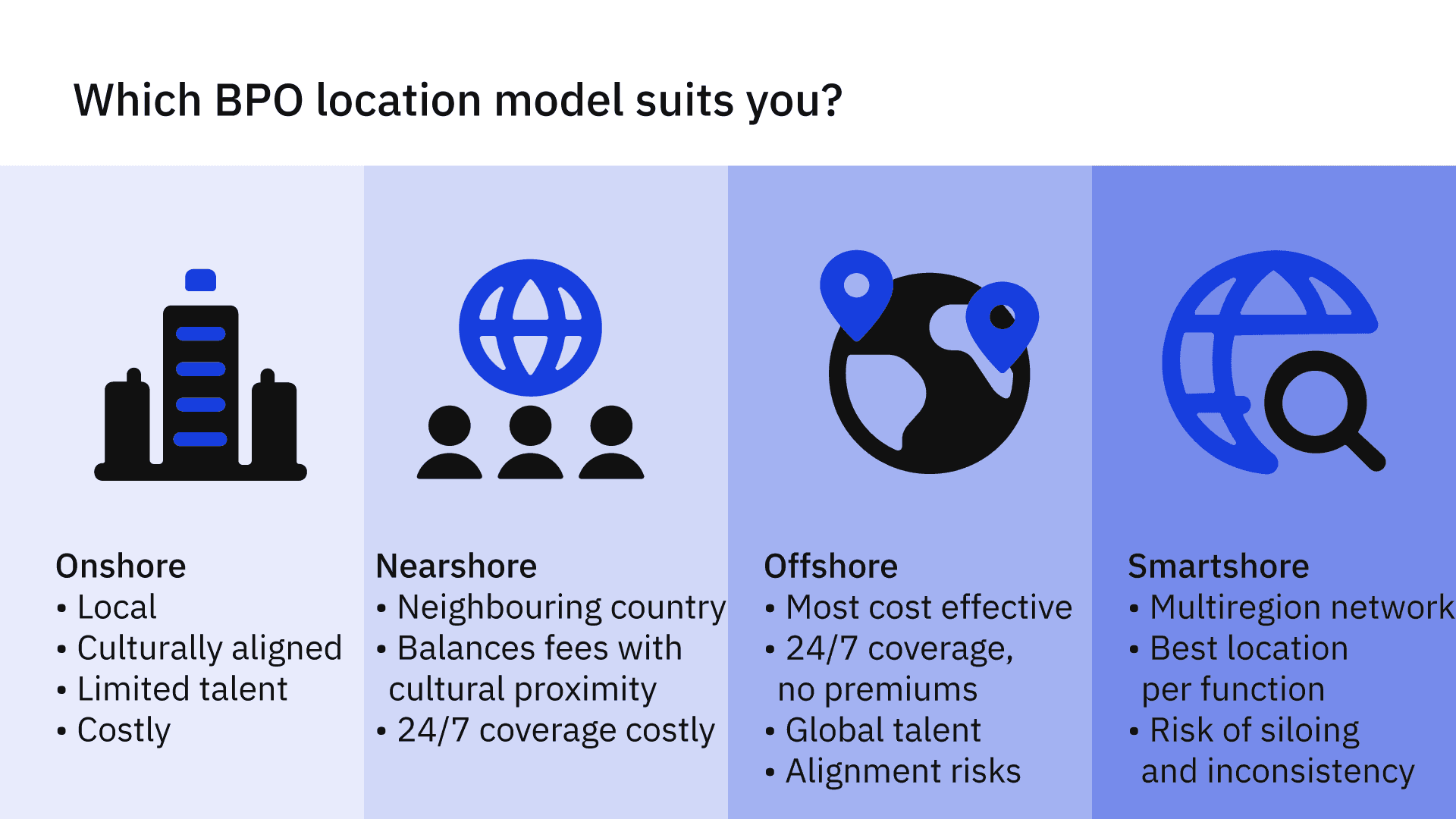
Many enterprise brands operating out of North America and Western Europe, offshore BPO to far-off geographical locations to maximise cost savings and timezone coverage. But that might not be what’s best for your brand or at this specific stage of business growth. How much you benefit depends on the right blend of cost, quality, and alignment. Here’s how various models compare:
- Onshore (domestic outsourcing): partnering with a provider located within your country offers you the highest cultural alignment and local market familiarity. But it comes with the highest costs and restricts you to a smaller local talent pool. Consider it for frontline functions in particular if your brand’s identity and customer satisfaction depend critically on locality, or if your priority is specialization without cost savings.
- Nearshore outsourcing: a BPO partner in a neighbouring country or similar region - e.g. Latin America for US brands, or Eastern Europe for Western European companies - can provide a balance of cost considerations, cultural familiarity, bilingual communication, and real-time collaboration across similar timezones (± 3-4 hours). However, as with onshore outsourcing, 24/7 functions still come at a premium, and back-office and technical support partnerships might be more efficient elsewhere.
- Offshore (farshore) outsourcing: choosing a BPO in a distant location, e.g. India or the Philippines for US companies delivers the most substantial cost savings, unlocks a vast talent pool, and makes 24/7 coverage affordable. However, miscommunication, misalignment, and limited oversight are real risks, especially with poor partner selection.
- Smartshoring: BPO leaders, especially in CX, now offer strategies combining offshore, nearshore, and onshore hubs united by advanced AI tools like real-time translation. You can position each distinct function in the most beneficial location, optimizing quality and cost, cultural alignment and global talent, as well as collaboration and timezone coverage simultaneously. But with the wrong partner, one key risk is siloing and inconsistency across regions.
Regardless of which BPO location strategy suits you best, none comes without its own risks and rewards. The key is carefully considering each according to your priorities, business roadmap, industry, and which specific functions you aim to delegate.
Navigating risks to maximize offshore BPO gains.
Among these models, offshore BPO often brings with both the greatest financial and strategic gains and the most significant risks. Entrusting a third party provider in a distant location with customer interactions, sensitive data, legal compliance or operational effectiveness requires prudence. Let’s break down these core threats - and the mitigation strategies top brands use to maximise offshore BPO’s benefits.
Communication and cultural barriers.
Working with highly diverse teams brings rich perspectives and skills, but it holds the risk of misalignment and miscommunication. Accent friction, tone inconsistencies, and differing cultural norms can create misunderstandings between your teams, or between brand representatives and customers. The second is especially significant in sensitive situations where emotions run high, including urgent inquiries in industries like finance and healthcare where clear, empathetic, and fast communication is critical.
Make sure to partner with BPOs that not only enforce deep brand immersion programs, turning their team into a natural extension of yours, but also undertake rigorous cultural coaching. AI-powered simulation training is one way CX specialists rapidly prepare for nuanced interactions, while today’s translation tools go as deep as real-time Accent Translation to ensure frictionless exchanges. Test your compatibility beforehand by conducting anonymous calls or requesting audio samples for a contact center prospect, for instance.
Loss of direct managerial oversight.
Even when teams speak the same language, distance and time asynchrony can introduce friction, siloing, and poor visibility. There’s a natural tradeoff between delegating to achieve specialization and sacrificing a degree of control over the function you choose to outsource. This may result in inconsistency, misaligned priorities, or role confusion regarding key decisions. That’s why it’s so crucial to understand how to select the right BPO partner.
Prevention begins with vetting your partner and establishing a clear, detailed contract. Insist on measurable, outcome-based with financial penalties and bonuses tied directly to performance. Determine chains of command and identify team members acting as designated points of contact. Trust doesn’t end after selection. Commit to weekly catchups, monthly assessments, and quarterly performance reviews to evaluate and refine alignment.
In conclusion.
Offshore BPO has evolved far beyond a basic cost-cutting tactic to become a strategic growth engine. By shifting non-core operations to specialized, compliant, and brand-aligned global partners, you stand to save 40% to 70% on overhead while gaining direct access to 24/7 operational capability, enterprise-grade AI technologies, and a world-class talent pool. At the same time, you secure the freedom to reinvest focus and capital back into your profit-generating core. With the right location strategy - whether pure offshoring or a smartshore blend - and a rigorous approach to partner selection and risk mitigation, outsourcing becomes a lasting competitive advantage. Ready to explore how our tailored, scalable CX solutions could fuel your brand long-term? Contact Transcom’s team today.
Read more
Created at Fri Oct 09 2026
10 min read
How to measure the ROI of customer experience investments: formulae, steps, and solutions.
Customer satisfaction might be key to long-term business success, but satisfying today’s CFOs and board members to secure the necessary investments takes hard financial evidence. Discover what CX ROI really means in financial terms and why it’s so critical to your bottom line. We break down the four-step framework you’ll need to measure it in practice - from establishing baselines and determining CX levers, to linking them to financial outcomes and calculating net returns. We’l