What it really takes to make AI work in customer experience: 5 strategies from our Frost & Sullivan win.

CX,
AI,
operations,
innovation,
leadership,
efficiency,
technology,
Award,
Published on Wed May 13 2026
Updated on Mon May 18 2026
5 minute read
Who can the world’s most ambitious brands trust for tech-enhanced CX that delivers? Separating trend-followers from those forging impactful solutions, Frost & Sullivan identified Transcom as a 2026 Technology Innovation Leader in both North America and Asia-Pacific. This recognition reflects a shift in how AI is evaluated in CX. It’s no longer about pure capability - it’s about ensuring that tools enhance real operations to boost efficiency and loyalty alike.
This makes all the difference at a time when 85% of AI projects fail (see AI at work: the hype, the truth, and what’s next). The most common culprit? It isn’t broken technology but a strategy that falls short. We’re all familiar with the tendency to slap AI onto existing processes piecemeal - and the expectation that hype will translate into miracles. Integration is a major blind spot. In fact, according to McKinsey's latest survey on the state of AI, nearly two-thirds of organizations have not yet begun scaling AI across the enterprise, despite widespread adoption.
Transcom’s approach stands apart. Rather than treating AI as a standalone, we root it deeply into workflows, decisions, and continuous improvement loops. Instead of bending agendas to rigid tools and use cases, we shape them around operational priorities. That’s what Frost & Sullivan’s Best Practices program recognized - so how can your organization follow suit? Let’s explore 5 actionable strategies behind the win.
Start with the constraint, not the use case
Rather than taking a suite of trending tools as given and forcing use cases to fit your functions, your best-performing CX operations begin with clarity. This means identifying the constraint that has the greatest impact on both cost and experience - and then applying AI to address it. In practice, teams typically start by analyzing performance gaps to identify root causes.
Repeat contacts, for instance, are inspected by interaction type, failure point, and source of friction. This allows them to determine whether the issue is driven by knowledge gaps, process breakdowns, or lack of continuity between touchpoints. And with our research revealing that 82 percent of customers use multiple channels to resolve a single issue, it’s easy to see why pinpointing operational challenges is critical. Of course, the right tech can help here too - our AI Insights, for example, analyze every conversation, interaction, and response to highlight areas for improvement based on data quantities no human could track.
Take our experience with a retail client facing a large volume of repeated inquiries. Examining the cause, we found that these were driven by a lack of continuity between interactions. Each new contact required an agent to reestablish context from scratch instead of moving ahead with a solution. Harnessing AI to enhance how case info was stored and surfaced, we empowered agents with each consumer’s conversation history, intent, and prior actions to ensure that resolution picked up right where it left off. This not only cut down repeated contacts, but slashed handling time and to boost customer satisfaction.
The lesson? AI creates the most value when it is applied to a precisely-defined operational constraint. With that in focus, the next step is redesigning how decisions are made within each interaction itself.
Bake optimization into structured decisionmaking.
Once priorities and solutions are established, high-performing operations teams don’t leave implementation to chance. They bring structure to critical moments by defining decision paths in advance, mapping customer intent and context closely to recommended actions. Then, they integrate tech into this step too. Tools like our AI Agent and Knowledge Assist consolidate and surface relevant information in real time so agents do not need to search across systems. Resolution steps are sequenced, guiding the interaction rather than leaving it open-ended.
These changes reduce decision variance. Rather than increasing speed as well as errors, these structured systems provide agents a streamlined path to success. And the evidence extends beyond CX: according to McKinsey, the organizations reaping the greatest returns from AI are nearly three times more likely to redesign workflows rather than simply deploy new tools.
At Transcom, utilizing AI in this manner has reduced handling time by 15 to 20% while maintaining customer satisfaction at up to 94%. It’s a testament to the power of tech integration to align decisions more closely to desired outcomes and build more reliable operations over time. But sustaining this consistency means taking embeddedness further, incorporating AI into a holistic system beyond isolated applications.
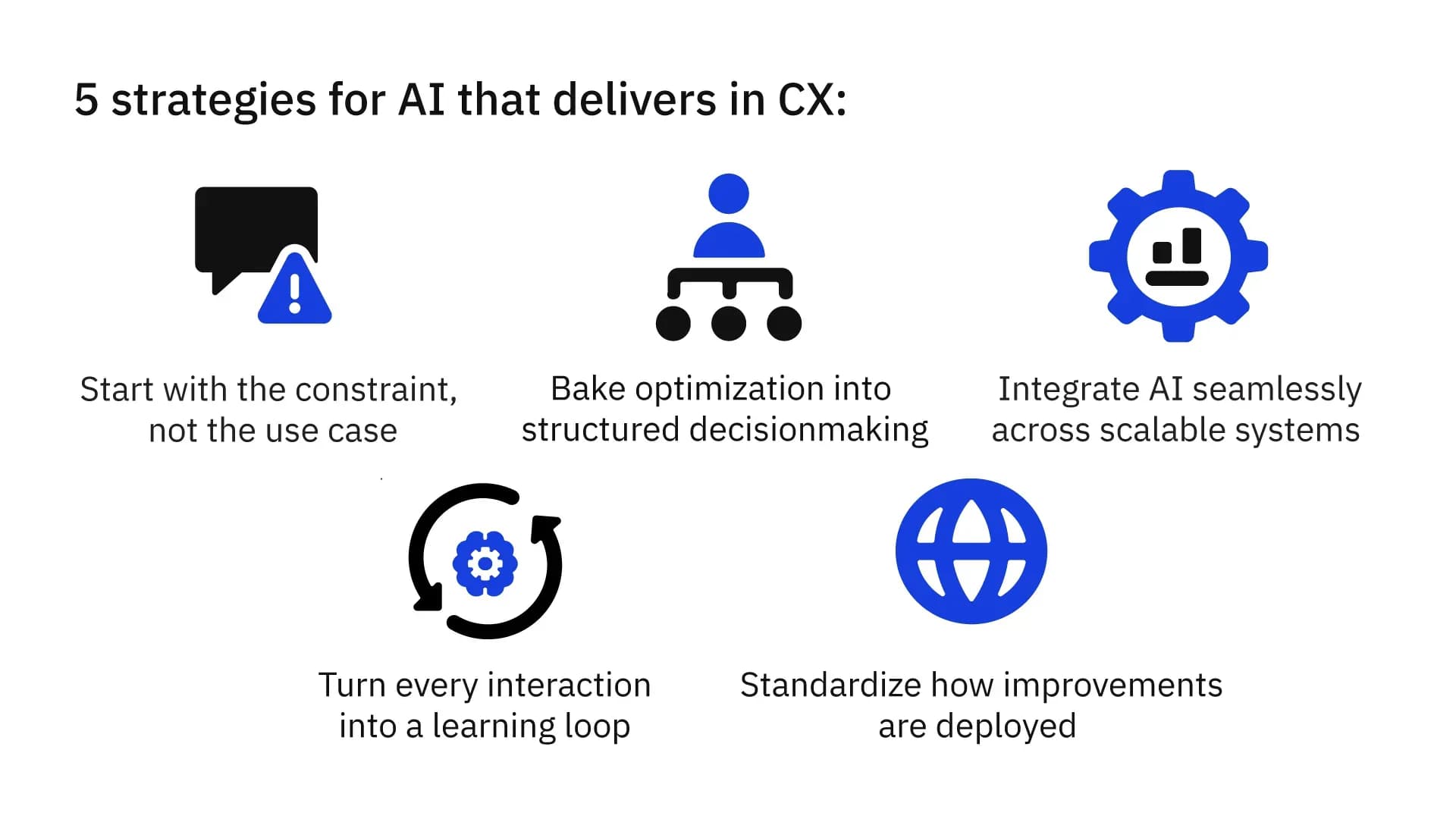
Integrate AI seamlessly across scalable systems.
Vital as it is, implementing AI to improve one targeted workflow is not enough. Left disjointed, in fact, tech can cause more friction than efficiency. What sets innovation leaders apart is taking on the real challenge of integrating solutions and improvements at scale - across teams, markets, and interaction types.
Mature CX teams address this by creating defined roles for AI that work in harmony across a connected system. Automation handles repetitive tasks. Real-time support strengthens decisions during complex interactions. Analytics identify patterns and feed continuous improvement back into the system. Insights are used to refine decision logic and workflows, while areas of friction inform how automation and guidance evolve. Solutions flow seamlessly every step of the way. Each component’s impact amplifies the rest.
In one global program, for instance, we applied this model across more than 2 million interactions spanning 25 markets. The results? We consistently delivered 100% SLA adherence and quality scores above 98% - about as close to perfection as it comes. It’s proof that scaling AI successfully is not about adding more tools, but designing a seamless system that works as one.
Turn every interaction into a learning loop.
Achieving a moment of AI excellence is one thing. Sustaining that performance and staying in the lead, however, depends on how quickly your system learns from evolving interactions.
Rather than separating knowledge, training, and execution, CX innovation leaders connect them - and the tech enhancing them - directly. Through iterative systems, information is not only delivered in context. It’s refined each time based on how agents use it: when guidance is adjusted or bypassed, that behavior becomes a signal, highlighting where workflows or decision logic need to improve.
Training follows the same pattern. Real interactions are analyzed to identify where outcomes vary or where additional support is needed. Those moments are then converted into targeted coaching and simulation, allowing agents to practice decisions under realistic conditions. With solutions like our AI Agent Trainer, this becomes another fulcrum in a tech-enhanced system.
Over time, this feedback loop ensures that each interaction optimizes the next. Guidance becomes more accurate, decisions become more consistent, and the system adapts to real operating conditions. It’s an approach Transcom has used to secure the consistency that keeps us ahead. With this virtuous cycle in place, the final step is making sure that improvements advance beyond best practices into real ones, every time.
Standardize how improvements are deployed.
Good CX environments succeed at generating rich insights. But if teams struggle to translate gains across teams, markets, or channels, the result is uneven performance and outcomes that vary depending on where and how the work is done. Great operations don’t face this. Instead, they standardize how improvements are deployed and extended across entire systems - whether that’s a workflow adjustment, a decision update, or a refinement to knowledge.
Locking this in includes updating decision frameworks, aligning knowledge delivery, and reinforcing changes through training and performance management. The goal is to ensure that a successful outcome in one part of the operation becomes the default everywhere, every time, and at Transcom, this works across a wide range of global markets, communication channels, and interaction. Yes, it’s challenging, but getting it right is the key to variability that decreases not just within teams, but across entire operations. That’s when AI becomes more than a spot treatment for individual interactions to approach its potential as a self-perpetuating engine for CX success.
In conclusion.
Cutting through AI hype and converting complex principles into a comprehensive, connected system driving clear benefits - that’s what earned Transcom the Frost & Sullivan 2026 Technology Innovation Leadership award in two of the most forward-looking markets. From maintaining focus on real operational priorities to standardizing learning loops at scale, these five practices are at the heart of how we integrate AI not as a "bolted-on" feature, but within the fundamental architecture of CX.
And with 82% of consumers staying loyal to a company primarily because of consistently excellent service, there’s no doubt that getting this right pays off. A move away from "AI presence" and toward "AI precision" in optimizing customers’ experiences is just what brands need. Now that the tools themselves are everywhere, the discipline and clarity to operationalize them successfully where they truly matter - across global markets and millions of interactions - is the ultimate differentiator.
Read more
Created at Fri Oct 09 2026
10 min read
How to measure the ROI of customer experience investments: formulae, steps, and solutions.
Customer satisfaction might be key to long-term business success, but satisfying today’s CFOs and board members to secure the necessary investments takes hard financial evidence. Discover what CX ROI really means in financial terms and why it’s so critical to your bottom line. We break down the four-step framework you’ll need to measure it in practice - from establishing baselines and determining CX levers, to linking them to financial outcomes and calculating net returns. We’l