How to measure the ROI of customer experience investments: formulae, steps, and solutions.
Transcom
Staff
Customer experience,
return on investment,
Published on Fri Oct 09 2026
Updated on Fri Oct 09 2026
10 minute read
Customer satisfaction might be key to long-term business success, but satisfying today’s CFOs and board members to secure the necessary investments takes hard financial evidence. Discover what CX ROI really means in financial terms and why it’s so critical to your bottom line. We break down the four-step framework you’ll need to measure it in practice - from establishing baselines and determining CX levers, to linking them to financial outcomes and calculating net returns. We’ll also cover solutions to the most common challenges, from isolating causality and filling data gaps to communicating your hard-won results compellingly, so you can accurately optimize investments and drive future growth.
What is CX ROI? Its true definition and formula.
When making the case for CX’s value, most emphasise metrics like net promoter score (NPS), a measure of how likely customers are to recommend your services, or customer satisfaction score (CSAT), a predictor of brand loyalty. Dismissing these as ‘vanity’ or ‘soft’ metrics is ill-advised. Rather, they’re lever variables affecting your bottom line over time. But how can you ultimately assess whether they’re working as promised - and adjust resource allocation and strategies accordingly?
That’s where customer experience return on investment, or CX ROI, comes in. Rather than a vague measure of happiness across programmes, CX ROI is the net financial return associated with a specific CX initiative. For a given customer experience initiative, the mathematical formula is straightforward:
CX ROI = (Financial gain - total costs) / total costs
where all gain and costs must be linked as directly as possible to the CX initiative itself.
The resulting value can be interpreted in two ways - either as a percentage or a return ratio. Careful, as the interpretation can be tricky and counterintuitive. Consider the 1.32 ROI we achieved with our multi-brand CX consolidation for a white goods leader. This means that for every euro our client invested, they received 2.32 - getting their euro back alongside another $1,32 in pure profits. Alternatively, multiply by 100 to compare percentages across competing investments - in this case, a 132% ROI.
To avoid an underestimate of CX ROI, always remember that financial gain includes both any revenue earned - for instance through a specialised cross-sale programme - and any cost savings - e.g., the associated reduction in marketing spend. To prevent an overestimate, account for every cost involved in making the initiative happen, from planning to software, training, employee time, change management costs, and even the resources involved in assessment and optimisation.
Simple as this calculation may seem, putting it into practice involves a lot of work - including data collection, expert analysis, and the practical steps and pitfall avoidance we’ll cover next. That said, the strategic business case is more than strong enough to warrant it.
Why CX ROI is vital for strategic business growth.
Every indicator your business calculates is an investment in itself. It takes time, expert analysis, careful planning, constant tracking, consistent review, and decisive action to yield accurate readings of the return on investment on your customer experience initiatives - and to translate these into action that fuels growth. So why put those resources into assessing customer experience? Crucial reasons to calculate and act on your CX initiatives’ return on investment include, but aren’t limited to:
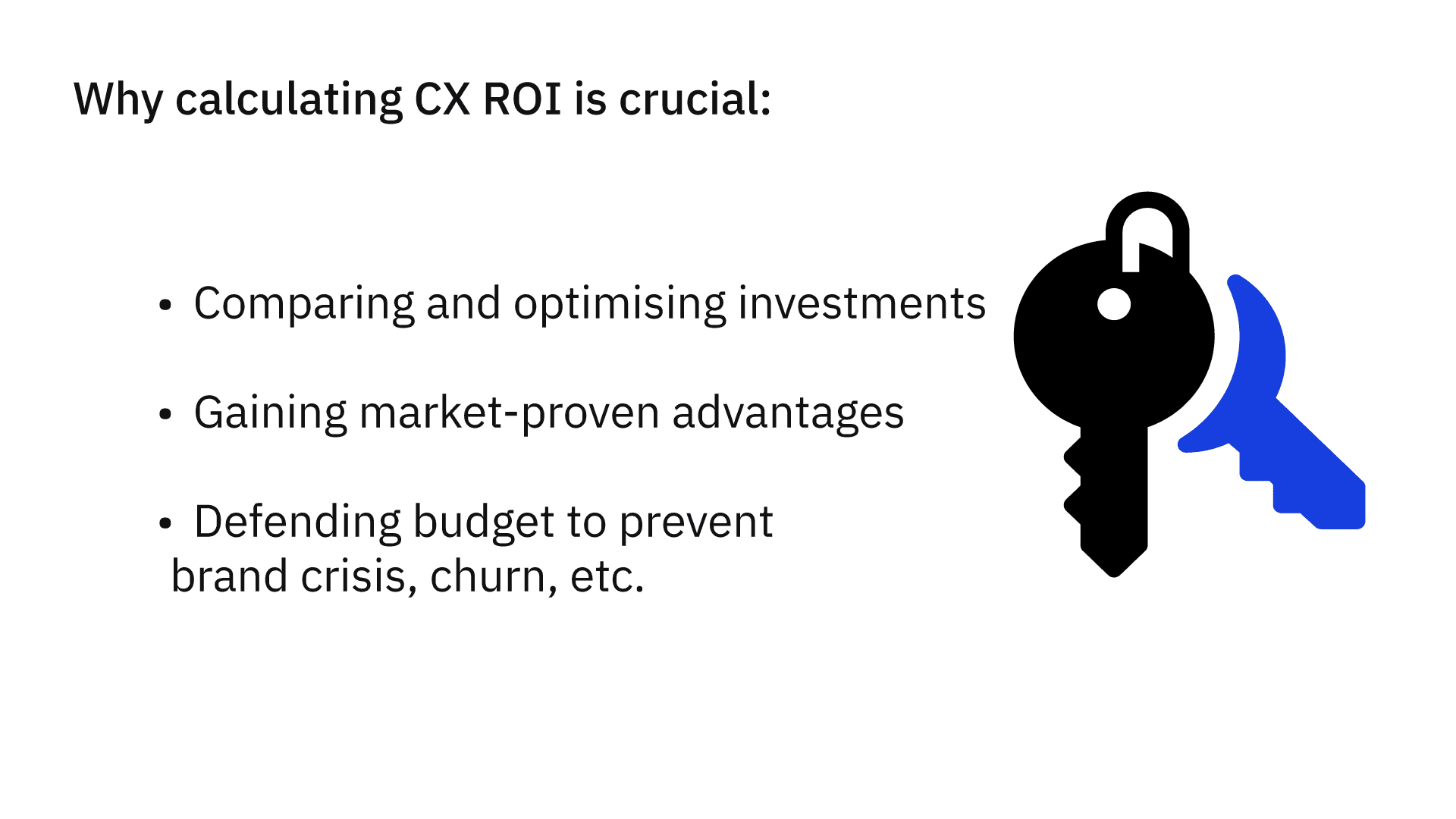
Translating macro-level benefits into your competitive advantage.
Market-level data overwhelmingly illustrates substantial benefits for brands that lead on CX. According to Deloitte, customer-centric companies are 60% more profitable. Forrester finds that brands with superior CX also generate 5.7 times more revenue. High CX maturity also grows profits 49% faster and organisations overall 41% faster than competitors, per the same report. While many remain stuck on the idea of CX as an unavoidable operational cost centre, measuring your own CX programmes’ specific ROI and refining them accordingly shifts this perception and allows you to turn industry boons into verifiable advantages for your own business.
Setting budgets and securing organisational alignment.
CFOs and boards no longer approve investments based on customer experience metrics alone; they insist on seeing CX’s direct impacts on revenue growth, profit margins, and stock price. But translating CX metrics into concrete financials doesn’t only enable you to decide between CX initiatives themselves. It makes it possible to compare them with marketing and sales programs, tech investments, and more. ROI is the unifying language that enables your business to optimise resource allocation and secure buy-in cross-functionally.
How to measure CX ROI in 4 steps: behind the formula.
Plugging values into the CX ROI formula is easy. But measuring the return on investment of your customer experience programmes means first carefully isolating the costs and benefits associated with one specific initiative in a sea of competing variables. The four-step approach begins with establishing baselines and protocols, linking CX to customer behaviour, linking those behaviours to financial outcomes, and only then calculating and reporting the net benefit. Let’s break it down:
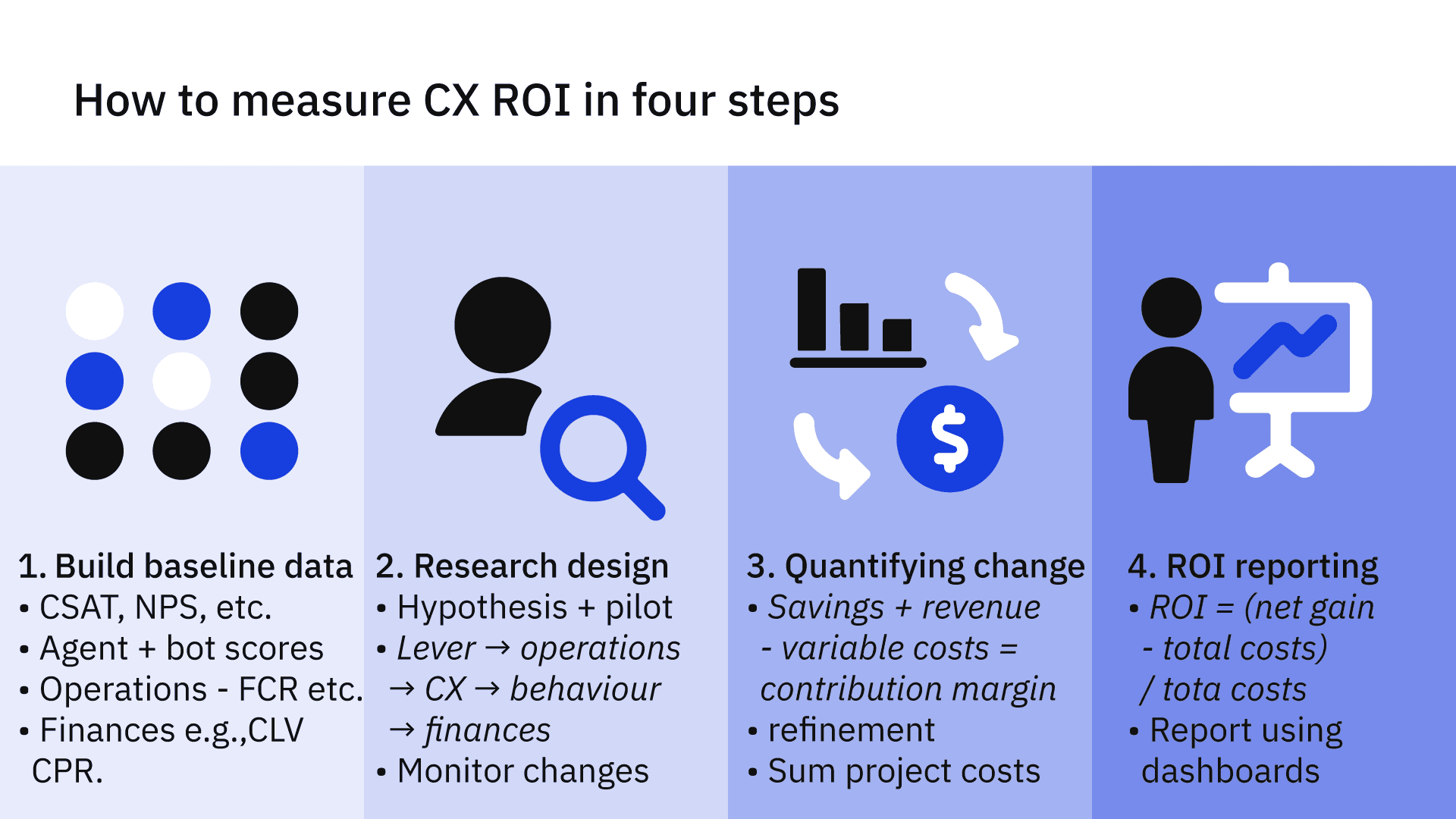
Step 1: Secure data, metrics and baselines.
Proving CX ROI is no exception to the rules of research. The first? Your outcome’s accuracy depends on clear variables, consistent measurement intervals, and precise baselines captured before your CX initiative takes effect. You’ll be attempting to link a change in CX performance to a change in customer behaviour - and an ultimate change in financials. This means you’ll have to select and audit the following categories of baseline data:
- Team health and performance metrics: For interventions rooted furthest upstream - in onboarding, training, recruitment, or agent experience - you’ll need to measure baseline employee engagement, attrition, satisfaction, and other relevant variables.
- Automation and AI performance metrics: Interventions centred on technology, e.g., an AI chatbot upgrade, require comparisons on bot resolution rate, LLM accuracy, and other indicators.
- Operational efficiency lever metrics: In every case, note accurate baselines for operational levers like first contact resolution rate (FCR) and first response time (FRT).
- Customer-focused CX metrics: Take precise recordings of your current CX-driven satisfaction and loyalty indicators that provide the link between operations and customer behaviour, e.g., net promoter score (NPS), customer satisfaction (CSAT), and customer effort score (CES).
- Financial customer behaviours: These provide the link between intangibles like satisfaction and the outcomes you need for quantifiable ROI, e.g., , a and incorporating both loyalty and purchase value into one metric of lifelong revenue per customer.
Proving CX ROI: 5 key challenges with solutions.
Without rigorous research behind it, your CX ROI is just an educated guess. Proving your figure’s precision - both to yourself and key decision makers - means explicitly addressing at least 5 key challenges. While establishing true causality takes enlisting experts, you can tackle the following obstacles fairly with the suggested solutions.
Challenge 1: confusing gross revenue with profitability. Remember our example? If we’d failed to subtract the variable costs associated with bot resolution, we’d be stating gross revenue as if it were profit. Our calculation would look very different. Doing the math yields a shocking 300% ROI. This would instantly destroy credibility before any CFO. Always use the contribution margin, subtracting cost-to-serve for a true economic value you can trust and share proudly.
Challenge 2: double-counting or miscounting benefits. Suppose your dashboard shows that the test group's annual revenue rose from a projected $400 000 (your average after normal churn) to $520 000. Assuming that this $120 000 increase can just be added on top of your $100 000 retention goal would be a critical mistake. You must look at the individual customer behaviors to see where that money came from. Did the bot actually prevent the $100 000 in churn, leaving $20 000 in net-new upsells? Or did the churn happen anyway, and the remaining clients simply spent more?
If you don't track the specific behavior, you risk double-counting the same dollars or misattributing your success. Be aware and, where possible, map every single financial benefit directly to its underlying customer behavior.
Challenge 3: Ignoring hidden project costs. This one’s easier to wrap your head around, but it’s also easy to slip up and forget a line item, overstating ROI by accident. Make sure to account for absolutely every expense to avoid presenting an artificially high number. Total costs must include obvious line items like software licenses and implementation, as well as hidden costs like staff training, employee time, change management, and ongoing administration. Run calculations by several team members for surety.
Challenge 4: Establishing true causality. Isolating your intervention’s impact from confounding variables - like seasonality, competitor failures, or broader economic trends - as well as unrelated internal shifts depends on sourcing and protecting your data wisely and approximating experimental methods as closely as possible. Utilize control groups, phased rollouts, and carefully monitored pilot programs to definitively prove that your CX initiative - and nothing else - drove the financial outcome.
This also requires navigating the validity - or lack thereof - associated with intangible metrics and natural sample variation. Customers may perceive chatbot ease, and therefore CES, as vastly easier or more difficult depending on tech literacy or demographic factors. Some may be more or less sensitive to frustration in general and on the particular day that CSAT surveys are administered. Treat sentiment, trust, and brand perception as vital predictive levers, but never present them to the board as financial ROI. To protect the integrity of these levers, strictly audit your survey timing, customer mix, and response volume to prevent bias from invalidating your baseline data. One powerful solution to biased, small samples and limited or inefficient tracking is our suite, including Conversational Analytics that automatically convert every single interaction into a rich source of data - and even surface patterns for you.
In conclusion.
CX ROI is the ultimate bridge between operational frontline improvements and executive-level financial growth. By establishing clear baselines, designing controlled pilots to isolate causality, and translating behavioral shifts into true financial gain, you can measure each initiative accurately, build a compelling business case, and optimise resource allocation through continuous feedback loops.
Ready to move beyond internal silos and achieve this level of strategic precision with maximum efficiency? Partner with Transcom’s data-driven, strategic CX experts to ensure that your investments consistently deliver measurable, bottom-line returns. From establishing rigorous measurement frameworks to executing expertly controlled operations, we provide the holistic partnership you need to turn customer satisfaction into an undeniable financial advantage. Contact us.
Read more
Created at Fri Oct 09 2026
10 min read
How to measure the ROI of customer experience investments: formulae, steps, and solutions.
Customer satisfaction might be key to long-term business success, but satisfying today’s CFOs and board members to secure the necessary investments takes hard financial evidence. Discover what CX ROI really means in financial terms and why it’s so critical to your bottom line. We break down the four-step framework you’ll need to measure it in practice - from establishing baselines and determining CX levers, to linking them to financial outcomes and calculating net returns. We’l