Call center pricing guide 2025: find the best fit for your business.

call center,
contact center,
pricing,
CX,
call center services,
costs,
Published on Fri Jul 25 2025
Updated on Fri Aug 08 2025
11 minute read
Seeking your next major strategic advantage? Investing in a brilliant call center is the perfect move to slash costs, skyrocket client satisfaction, and spur sustainable growth. Offering 24/7 support, access to top talent and tech, and unparalleled efficiency, it’s no wonder the right CX hub sets winning brands apart.
But in a crowded provider market, how can you secure the ideal partner and identify a call center pricing model optimized for your needs? From unpredictable expenses and ROI to concerns over control, evolving customer expectations, and today’s sophisticated tools, leave the analysis paralysis to competitors. Our comprehensive guide demystifies it all, empowering you to find a CX unicorn that powers your bottom line.
Understanding your needs: inbound, outbound, and contact vs call center pricing.
Ever hit the mall without a plan, only to splurge on something you regret? Unlike a fast fashion impulse buy, commissioning the call center pros without adequate research gets you tied into contracts and continuous costs. To strike the best deal, you must know what you need, want, and are willing to spend. We’ve broken down the plethora of call center offerings into two simple sets of considerations.
Call center vs contact center costs.
Today’s customers are accustomed to having their pick of communication methods, from calls to chat, socials, and video. To win and keep their loyalty in a competitive landscape, delivering the convenience they expect is key. That’s why futureproof brands go beyond voice-only call centers, opting for contact centers instead. These include calls alongside while incorporating all your customers’ favorite channels to meet them where they’re at.
While contact center costs lean higher, accounting for broader support and advanced technology, the best omnichannel solutions harness innovative automation and self-service to skyrocket efficiency for sizable savings. Plus, integrating cross-platform customer insights secures satisfaction through personalization while facilitating strategic sales. Eager to discover the powerful tech turning CX hubs from crucial costs into profit centers? We’ll reveal it all, so read on.
Inbound vs outbound operations.
What turns a contact hub into a proactive profit center? One vital factor is who reaches out. Inbound call centers handle customers’ communications swiftly, providing support, technical assistance, and crucial order and billing info. The perfect reaction is key to customer loyalty and securing lifetime value. But what about sneaking issues that drive silent churn, or high-value prospects who need your brand but just don’t know it?
That’s where outbound operations shine. From lead generation and telemarketing to surveys, debt collection, and customer check-ins, outbound contact centers enable agents to initiate and follow up, engaging clients actively to glean real-time feedback while expanding your market share. Regarding call center pricing, incorporating outbound can increase costs by nearly 30% due to performance-based pay, data charges, and more. However, investing in blended centers combining inbound and outbound turbocharges ROI, unlocking growth in hypercompetitive markets.
In-house vs outsourced call center pricing.
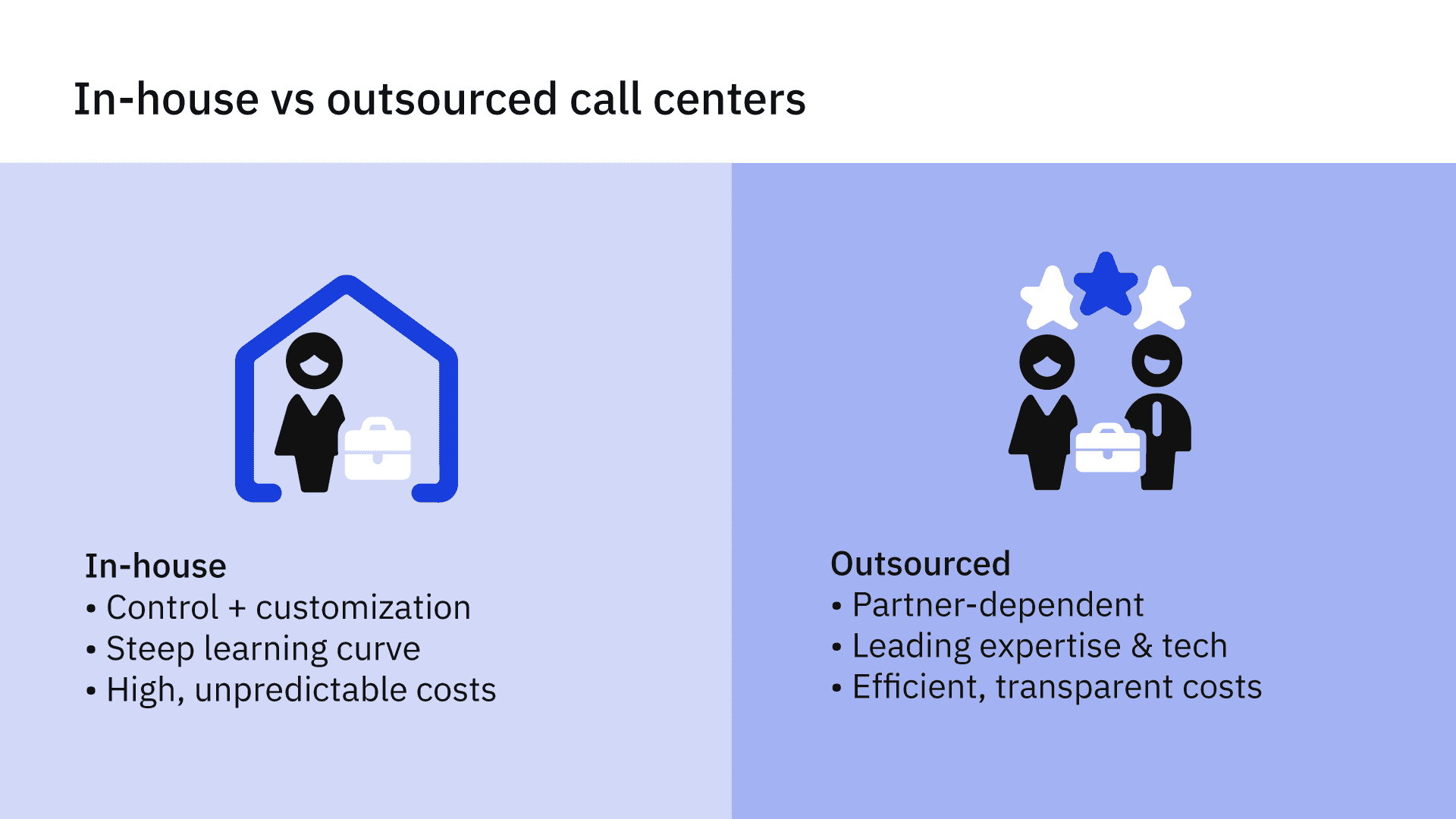
It’s easy to get excited once you know what you’re after, but don’t wind up with the CX equivalent of a DIY bowl-cut. Whether you bring in the pros or go solo profoundly impacts operational costs, flexibility, and, ultimately, client success. Outsourcing cuts call center costs by 30-50%, with offshoring saving you 40-70% compared to typical in-house operations. With such dramatic margins at stake, informed decisions are critical.
In-house call center costs.
Before sophisticated providers emerged, in-housing was the default. Even as outsourcing gains traction, some brands still opt for internal CX, seeking to customize and control their business’s primary touchpoint with clientele. Doing so successfully, however, means taking on and mastering a whole new function - one that diverts valuable time and effort from core operations. It’s an expensive one too, requiring considerable investments in:
- Talent acquisition & development. Recruiting, hiring, and training costs amount to thousands per agent and increase with technical expertise, not to mention ongoing salaries, benefits, taxes, and incentives for agents and management. Replacement costs are also substantial, with in-house attrition rates typically higher, oftentimes due to staff’s dual responsibilities.
- Technology & infrastructure. Beyond per-seat costs such as hardware and headsets, overheads entail Customer Relationship Management (CRM) platforms, network infrastructure comprising routers, firewalls, and setups, monthly business internet, and, notwithstanding today’s Voice over Internet Protocol (VoIP), significant telephony costs.
- Facilities. Even humble office rents can be exorbitant in major cities, and that’s excluding utilities, furniture, supplies, and maintenance. While hybrid and work-from-home models reduce overheads, these also reduce the direct control.
- Compliance & QA. In an age of increased regulatory complexity, compliance is costly. You’ll need experts to navigate generalized requirements, such as HIPAA, GDPR, SOC 2, and ISO 27001 governing data and security, as well as industry-specific add-ons, e.g., the Payment Card Industry’s PCI. Falling short brings hefty fines on top of QA staff’s salaries and audit fees.
While these categories provide a blueprint, the true scope of costs includes countless additional details and unexpected expenses. When determining the best approach for your business, don’t forget that each resource dedicated to in-housing comes at the expense of investment in your profit-driving core.
Common call center pricing models.
Any CFO would agree that predictability is priceless when it comes to strategic budgeting that boosts ROI. Outsourced call center pricing offers just this, replacing the erratic and multifaceted costs of in-housing with transparent fees charged according to measurable models. Let’s figure out which works best for your business needs.
Per agent pricing.
Need sophisticated software and a stable, specialized team? Consider a fixed monthly or annual fee per agent. That way, you’ll benefit from relatively high retention rates, prioritizing committed talent that’s thoroughly trained and equipped. The tradeoff? Limited flexibility and slow scale responsiveness.
Hourly pricing.
This intuitive call center pricing model bills businesses a flat rate per hour that agents work, e.g., 20 agents x 30 hours each = 600 billable hours. At $25 an hour, that’s $15 000 in total, with salaries, benefits, technologies, and more all included - a no-fuss matter of multiplication.
Want dedicated agents who embody your brand without per agent pricing’s commitment? Hourly pricing might be for you, especially if high, consistent call volumes warrant a full-time team equivalent. With no incentive to rush interactions, agents prioritize in-depth care. Plus, costs are predictable over stable volumes. Facing low call demand or frequent fluctuation? Consider alternatives to avoid paid downtime.
Pay per minute.
For more precise pricing, some providers charge for agents’ exact minutes of talk time. For instance, 5 agents x 2000 minutes = 8000 billable minutes. Flat rates aren’t uncommon, but many offer tiered rates with returns to scale, e.g., $1 each for the first 1000 minutes and $0.75 per minute beyond that.
If you face seasonal peaks or dynamic demand with major fluctuations, you’ll appreciate this model’s flexibility and scalability. You only get, and pay for, what you need, optimizing your budget. However, costs can shoot up if demand turns strong, particularly with fixed-rate providers. Agents may also be incentivized to prolong calls, making excellent workforce management decisive.
Pay per call / per interaction.
How about paying agents per call, email, or chat? This option keeps costs watertight for brands ordering a set package of interactions, typical of outreach campaigns.
Unlike time-based options, this call center pricing model gives agents no incentive to prolong clients’ calls. However, it can encourage them to rush towards quantity targets, compromising interaction quality. Again, managerial brilliance is key.
Pay per performance.
What factors influence call center pricing?
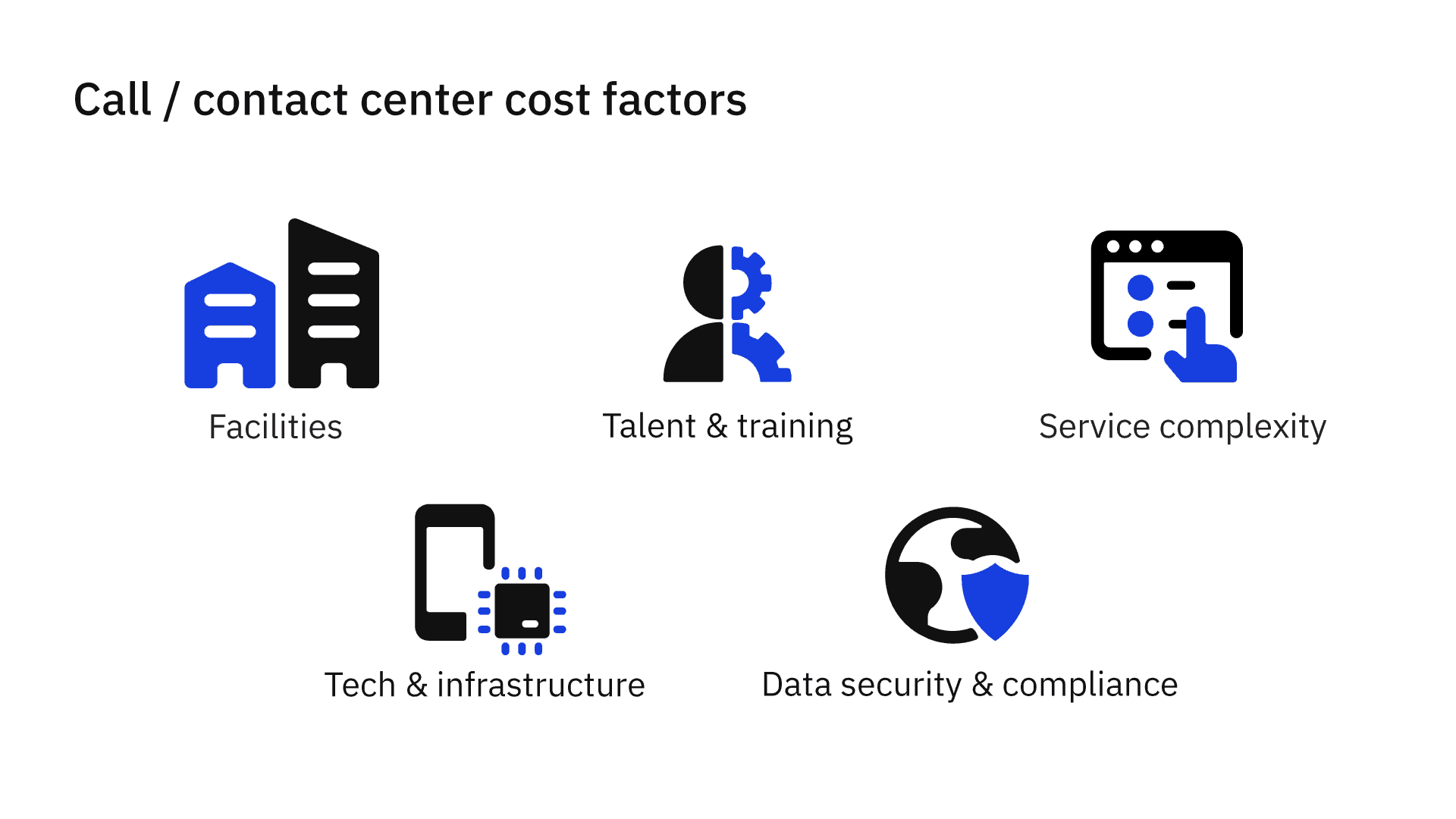
Imagine hiring a gardener for a competitive hourly wage only to discover they’ve got no shovel. To assess call center pricing soundly, you’ll need to know what’s behind the rate. Whether you insource or outsource, stick to inbound or expand are just some of the factors determining call center costs, and, crucially, quality. Let’s dive in.
Call/contact center service complexity.
You wouldn’t expect brick phone prices for a smart device that merges your laptop and camera in a pocketsize package. Complex offerings require a greater investment, including comprehensive omnichannel, blended contact centers. Pricing increases with each add on, from specialized tech support to market research, powerful performance metrics, and customer insight. If you’re strategic, however, this pays handsomely.
Agent costs.
What’s the largest call center cost driver? CX is all about human interaction, placing agent costs near the top. Be sure to factor in agents’ time and expertise, keeping in mind that rare languages and niche know-how like tier 2 tech support can increase fees.
Office space and facilities.
Happy, well-managed teams sustain stellar performances. That’s why we budget for a healthy, well-equipped workspace. Rent, utilities, furniture, supplies and ongoing maintenance expenses add up, but cutting corners only lead to long-term losses. Our smart solutions include hybrid and remote setups, boosting productivity and top talent retention while keeping costs manageable.
Call center software pricing.
Turning outstanding agents into call center superheroes? That takes swapping out basic voice and metrics tech for a lucrative investment in multichannel solutions offering integrated insights. Competitive centers also need IVR, automatic call distribution, routing, and recording, predictive dialing, surveys, and escalation. Our state-of-the-art AI solutions extend beyond these to encompass real-time analytics, automatic translation, data-driven training, 360-degree customer profiles and more for enhanced personalization and superior support and sales.
Cloud-based vs on-premise hosting also affects pricing. The former offers flexible scaling, a pay-as-you-go approach, automatic updates and minimal maintenance, with fees factoring in subscriptions and bolt-on features. Those preferring the latter cite control over data and security. Some save long-term through scale - a risky bet. Towering upfront infrastructure expenses, in-house IT and tech support, APIs, repairs, and upgrades contribute to making on-premise costs steeper and less responsive, while hybrid hosting combines the pros and cons of both.
Smart ways to optimize call center costs.
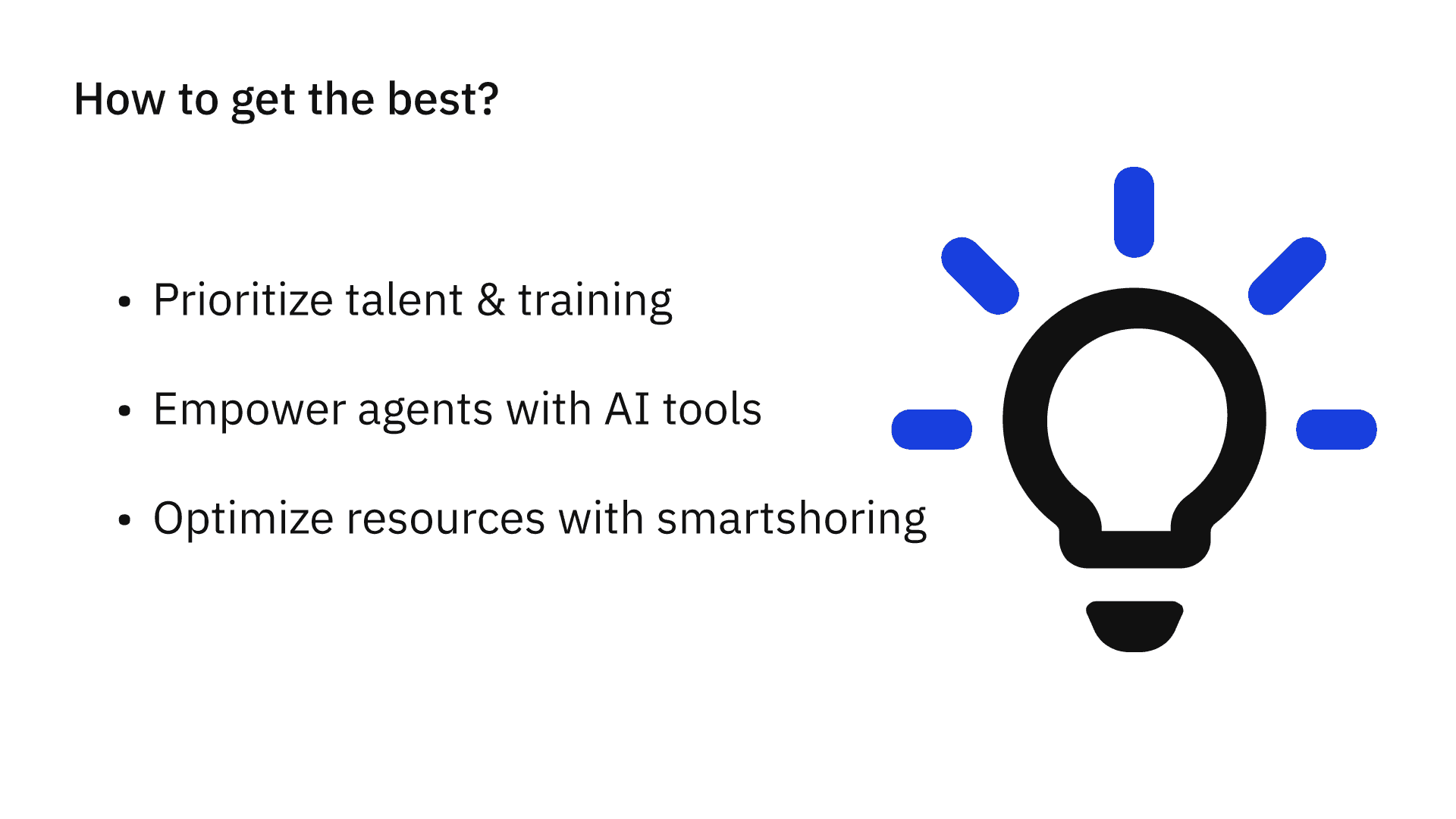
People, tech, and places. These aren’t trivia categories. They’re the factors determining call center pricing and performance in a nutshell. How do the best in the business hack each one, giving you stellar CX with streamlined costs? Understanding three sophisticated strategies will help you spot a savvy partner.
Training & retaining world-class talent.
Want to win clients’ hearts and reap lasting loyalty? You’ll need personnel who seamlessly blend personalized care with profound expertise. But securing top talent in a competitive market means combining attractive pay with excellent conditions. What’s the secret to controlling costs?
Investing in training and incentives sounds counterintuitive, but it’s just that - an investment that pays dividends. Skilled, satisfied agents work accurately, efficiently, and with infectious positivity that delights customers for lifelong patronage. Excellent agent management also cuts out expensive errors and boosts first-contact resolution while slashing attrition, preventing replacement and reputational costs alike.
At Transcom, we prioritize our people to provide best-in-class CX. This means crafting rich, progression-filled career paths where competitors lose talent to stagnation and rewarding excellent performance consistently within an unmatched environment. Combined with our AI Agent Trainer for continuous data-driven development, this keeps agents at the top of their game on both morale and performance. It’s an ROI win-win.
Human empathy meets AI efficiency.
Skyrocketing efficiency with state-of-the-art technology. In modern business, it’s the name of the game. Providers do more with less, consumers get more for less, and call center pricing is no exception. What are the cutting-edge tools we use to harmonize human connection with futureproof automation?
Training isn’t the only area where advanced tech complements our top talent. We’ve engineered a comprehensive suite of innovative, end-to-end solutions that keep Transcom at the frontiers of CX on everything from quality to cost and beyond. Our ethos? We don’t replace people with tech. Instead, we harness automation to free our call center superstars from routine tasks, saving their brilliance for priority interactions. Our AI Voice and Text Bots tackle inquiries 24/7, reducing inbound calls while delivering swift, satisfying resolution. Meanwhile, Transcom’s AI Callbacks manage peaks and streamline contact while boosting convenience.
In conclusion.
With CX more competitive than ever, the race is on for peak satisfaction that keeps your client base loyal and growing. It’s time to put your newfound knowledge into action and enlist a contact center unicorn who’ll set you miles ahead of competitors, combining superior service that dazzles with a cost structure that empowers you throughout your journey.
Ready to embrace world-class talent, state-of-the-art tech, and access to global hotspots delivering unbeatable value? Choose Transcom for a truly nimble partner leading the globe on efficiency, innovation, and customer delight. From pay per minute’s flexibility to TCO’s efficiency gains, we go beyond offering a full range of pricing models suited to your strategy. We transform cost centers into profit hubs, securing lifelong value relationships, enhancing brand reputation, and gleaning rich, real market and client insights that inform your strategic growth. Trust us and scale seamlessly with the power of brilliant CX.
Read more
Created at Fri Oct 09 2026
10 min read
How to measure the ROI of customer experience investments: formulae, steps, and solutions.
Customer satisfaction might be key to long-term business success, but satisfying today’s CFOs and board members to secure the necessary investments takes hard financial evidence. Discover what CX ROI really means in financial terms and why it’s so critical to your bottom line. We break down the four-step framework you’ll need to measure it in practice - from establishing baselines and determining CX levers, to linking them to financial outcomes and calculating net returns. We’l